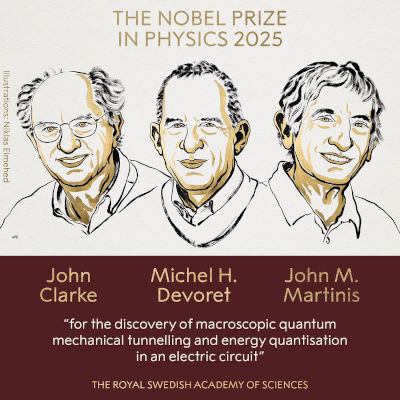

The Nobel Prize in Physics for 2025 goes to John Clarke, Michel H. Devoret, and John M. Martinis. They found evidence of macroscopic quantum mechanical tunneling and energy quantization in an electric circuit. Tunneling is a quantum effect where a particle can pass through a barrier it does not have enough energy to go over, like going straight through a wall. Energy quantization means energy can only be absorbed or released in specific amounts, not any amount. Usually, these effects only show up at the microscale, but the new Nobel laureates showed they can happen in larger, hand-held setups.
They used superconductors. In superconductors, electrons form pairs called Cooper pairs, which act together as one big group. This group can be described by a wave function that shows the chance of where particles are and what they do. The scientists built a circuit on a small chip with a Josephson junction, a setup where two superconductors are separated by a thin insulating layer that normally blocks current.
The groundbreaking experiments
In 1984 and 1985, the new Nobel laureates ran tests at Berkeley. They sent a weak current through the circuit, starting in a state with no voltage, trapped like behind a barrier. Through tunneling, the system escaped, creating a voltage that they measured. This showed macroscopic tunneling, where billions of Cooper pairs acted as one giant particle tunneling together. They also added microwaves, and saw the system absorb only certain amounts, proving energy levels are quantized even on this scale. They measured how long the zero-voltage state lasted over many trials, like tracking half-life in radioactive decay, where half-life is the time for half of something unstable to change.
This work builds on ideas from earlier physicists, like George Gamow who explained nuclear decay with tunneling in 1928, and Brian Josephson who predicted effects in junctions. It opens doors for new tech. For example, these circuits act like artificial atoms and help in quantum computers, where qubits use energy states for zero and one.