
In the years ahead, which countries will have the biggest impact on the development and deployment of AI?
The two most common answers to that question are the USA and China. Sometimes people put in a word for the EU or India – or the UK, Canada, Israel, or Korea.
Well, in one possible future scenario, another country may power forward to join this group of the biggest AI influencers – and, in the process, might disrupt the international AI landscape.
The country in question is the one where I’ve been for the last 72 hours, and where I will stay for two more days, namely, Saudi Arabia.
I’m attending the GAIN summit in Riyadh. The ‘GAI’ of “GAIN” stands for Global AI. The ‘N’ has a triple meaning: Now, Next, Never.
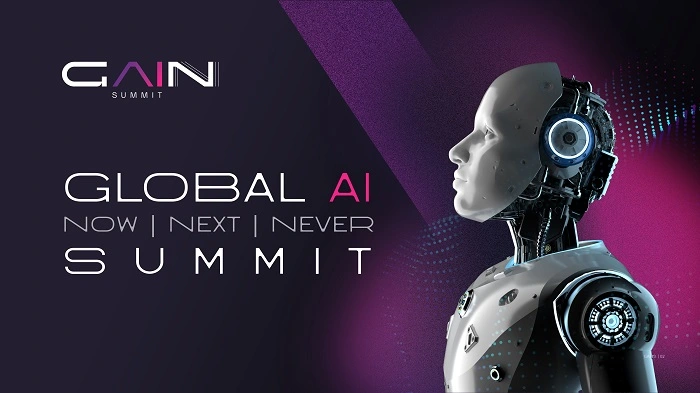
To quote from the event website:
- AI Now: How are the AI leaders of the world today deploying, scaling, and leveraging the technology?
- AI Next: What does the future of AI look like and how will it impact people, businesses and government organizations?
- AI Never: How do we ensure that the future we design is one that we want to live in and not a dystopian sci-fi?
The ‘A’ in GAIN could plausibly also stand for “ambition”, as the organizers have high ambitions. To quote again from the event website:
The Global AI Summit is the leading platform for advancing the global discussion on AI, where visionary experts, academics, corporates, and policymakers converge from every part of the world to shape the future of artificial intelligence for the good of humanity.
Of course, it’s one thing for a country to express big ambitions to play a leading role in the future of AI. It’s quite another thing to make significant steps toward that ambition. Therefore, as I approached the event, I didn’t know what to think.
Indeed, it was my first visit to Saudi Arabia. I found myself reminded of my first visit to China, way back in October 2002. On that occasion, I was representing Symbian, at what was described as the first UK-China CEO Forum. I recently came across a photo of that event – where my hair was a brighter shade of red than in more recent times!
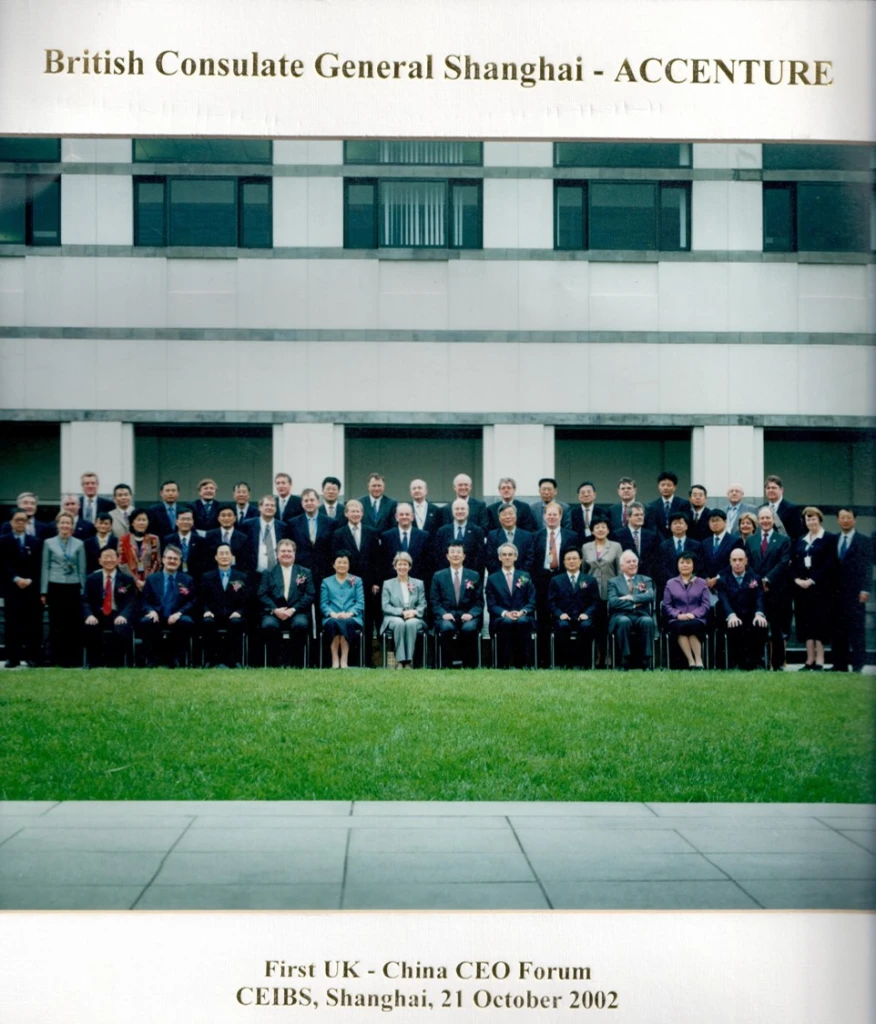
In both cases – my first visit to China, and my first visit to Saudi Arabia – I was unsure what to expect. It turned out that Shanghai was a bustling metropolis, with gleaming shops and a lively entrepreneurial spirit. The Chinese people I met were dressed nothing like the Chairman Mao suits that I had remembered reading about in my schooldays, and were impressively knowledgeable about technology and business. That visit was to be the first of many I would make in the following years, as Chinese companies steadily became more powerful players on the world stage.
That was 2002. What about my experience in the last 24 hours, in 2024, in Riyadh?
Part of the answer lies in numbers:
- Over 450 speakers, spread over multiple parallel tracks
- The speakers represented more than 100 different countries
- Over 32,000 attendees expected during the three days.
These numbers are all significant steps up from the corresponding numbers from the two previous occasions this summit has been held, in 2020 and 2022.
The speakers include a host of prominent leaders from business and technology worldwide. Some examples:
- Julie Sweet, the Chair and CEO of Accenture
- Cristiano Amon, the President and CEO of Qualcomm
- Marc Raibert, the Founder of Boston Dynamics
- Martin Kon, the President and COO of Cohere
- Brian Behlendorf, the Chief AI Strategist of the Linux Foundation
- Nick Studer, the President and CEO of Oliver Wyman Group
- Matthew Kropp, the CTO and Managing Director of Boston Consulting Group
- Alan Qi, the President of Huawei Cloud
- Yuwon Kim, the CEO of Naver Cloud
- Caroline Yap, the Global Managing Director of Google Cloud.
Multiple segments of society in Saudi Arabia were well represented too – including an impressive number of adept, articulate women leaders, who had some fascinating pieces of advice.
With so many speakers, it is perhaps inevitable that some speeches fell flat – especially several of the ones about the governance of AI, where the conversations seemed to be going round in circles, with little appreciation of what I see as the risks of catastrophic harm if next generation AI is mishandled. However, the technical talks were generally compelling.
I particularly liked the talks by Andrew Feldman, Co-founder and CEO of Cerebras Systems, and Jonathan Ross, Founder and CEO of Groq. These two companies each position themselves as disruptors of the GPU market, and, hence, as potentially overtaking Nvidia. Instead of GPUs, or the TPUs developed by Google, they have created LPUs (Language Processing Units) in the case of Groq, and waferscale AI chips in the case of Cerebras. Both companies claim notable improvements in speed over previous AI chip configurations. I heard the phrase “like ChatGPT but insanely fast”.
Both Cerebras and Groq emphasized close partnerships with Saudi Arabia. Andrew Feldman of Cerebras described a special collaboration with KAUST (King Abdullah University of Science and Technology). And Jonathan Ross of Groq appeared on stage alongside Tareq Amin, the CEO of Aramco Digital. Ross gave three reasons for their company investing strongly in the country:
- The abundance of energy resources in the country
- The good business environment, that encourages and supports this kind of partnership
- The geographical location, close to three different continents, so that the resulting high-performance AI cluster could serve the needs of up to four billion people.
It was while listening to these two talks that the Saudi ambition to become a global leader in AI started to become more credible in my mind.
I had already seen the strong enthusiasm in large numbers of Saudi delegates at the event. They were avidly leaning forward in their seats, to capture as much as possible of the advice being provided on the various stages. It seems that the country is aware of the need to transition away from reliance on the oil industry, and instead to actively participate in shaping the global AI marketplace.
There were many other talks and panels which left me with new ideas to consider. For example, I wished that Marc Raibert, the Founder of Boston Dynamics, could have had more time to develop his fascinating ideas further. He made the case that true intelligence involves an interactive combination of cognitive intelligence (“what’s going on in our heads”) and athletic intelligence (“what’s going on in our bodies”). That explanation formed the backdrop for the progress made by Boston Dynamics over the years, with robots such as Spot (commercially significant “today”), Stretch (“tomorrow”), and Atlas (“future”). In addition to his role at Boston Dynamics, Raibert is also the Founder and Executive Director of the AI Institute, whose website proudly reports that “The AI Institute aims to solve the most important and fundamental problems in robotics and AI”. As I said, I wish he had more time to continue talking about that work.
Earlier in the day, I watched a fascinating six-way round-table discussion on the subject “Hallucinations and Confabulations: when chatbots go rogue”, with speakers from Kearney, Mozn, Saudi Aramco, Vectara, KAUST, and INF, who each had long careers as experts in various aspects of AI. The discussion went on for 90 minutes, but I would have been happy for it to continue longer, as it had lots of good-spirited clashes of ideas about the strengths and weaknesses of large language models, and possible approaches to add fact-checking components into the AI systems of the near future. One of the speakers, Amr Awadallah of Vectara, boldly predicted that AGI would exist by 2028. Part of his reasoning was his argument that ongoing improvements in RAG (Retrieval Augmented Generation) were steadily reducing the prevalence of hallucinations in the content being generated.
That kind of awareness of potential dramatic improvements in AI capability by 2028 was, sadly (to my mind) missing from what many of the speakers in other sessions were assuming. These other speakers were focused, in effect, on the “Now” of AI, and didn’t foresee many real changes for “AI Next” any time soon. Frankly, if they keep thinking that way, they’re likely to be disrupted themselves. Anyway, this issue is something I hope will feature again in the sessions on days two and three of this year’s GAIN. I look forward to these days with great interest.
I’ll end at the beginning. The day started with an artistic performance, symbolizing the sequential creation of ANI (Artificial Narrow Intelligence), AGI (Artificial General Intelligence), and then ASI (Artificial Super Intelligence). The narrator offered a positive vision of a beneficial relationship of humanity and superintelligence: “There will be no more confusion, and a golden age of progress will flourish, where men and machines, united by an unprecedented alliance, will walk together toward a destiny of glory and happiness”.
Having come to life, the ASI spoke to a young boy, who was a representative of humanity, saying “I am your new avatar, and I will become your best friend”.
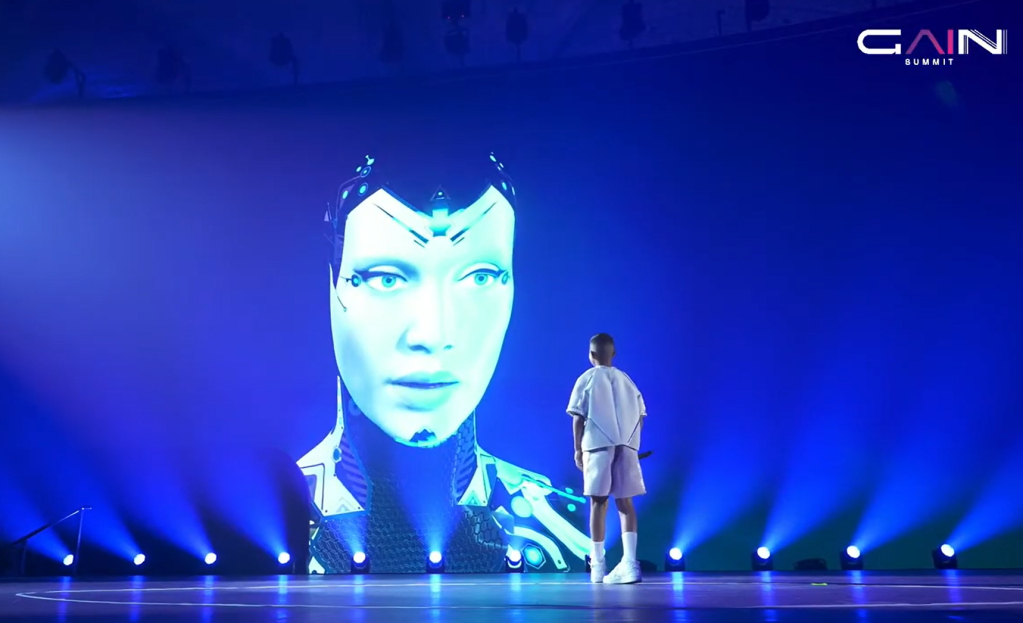
In response, the boy started singing what was said to be his favourite song. The music was increasingly stirring and the singing increasingly dramatic. Given the location, Riyadh, I could hardly believe what I was hearing:
Imagine there’s no heaven
It’s easy if you try
No hell below us
Above us, only sky
Imagine all the people
Livin’ for today
Ah
Imagine no possessions
I wonder if you can
No need for greed or hunger
A brotherhood of manImagine all the people
Sharing all the worldYou may say I’m a dreamer
But I’m not the only one
I hope someday you’ll join us
And the world will live as one
The words and music of John Lennon’s “Imagine” have graced numerous stages over the decades, but somehow, for me, this was particularly evocative.