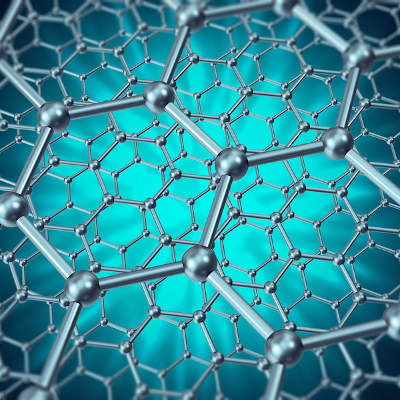

Electrons behave in unusual ways in pentalayer graphene, which is five layers of graphene stacked with boron nitride in a specific configuration. Graphene is a super-thin material made up of carbon atoms arranged in a hexagonal pattern.
Normally, when we think of electrons, we imagine them as whole units carrying a single negative charge. However, in some rare situations, electrons can split into smaller, fractional charges.
Typically, this splitting requires a very strong magnetic field. But electrons in pentalayer graphene showed this behavior even without a magnetic field.
The splitting is called the "fractional quantum anomalous Hall effect," where "anomalous" means it happens without a magnetic field. MIT scientists have developed a new theory to explain this. They figured out that in this special setup, electrons aren't just moving around freely; instead, they interact with each other due to being so closely packed in two-dimensional space.
This interaction leads them to form what could be described as a "crystal" of electrons, where their positions and movements become highly correlated.
This electron crystal isn't like a normal crystal where atoms sit in fixed positions; it's more like a dynamic cloud where electrons' quantum states (or wavefunctions) are intertwined in a way that allows them to exhibit fractional charges.
Research directions for new quantum technologies
The MIT scientists have described the methods and results of this study in a paper published in Physical Review Letters.
“This crystal has a whole set of unusual properties that are different from ordinary crystals, and leads to many fascinating questions for future research,” says research leader Senthil Todadri in an MIT press release. “For the short term, this mechanism provides the theoretical foundation for understanding the observations of fractions of electrons in pentalayer graphene and for predicting other systems with similar physics.”
Understanding strange electron behavior in exotic materials could lead to new quantum technologies, where manipulation of quantum states at an atomic or molecular level is crucial.