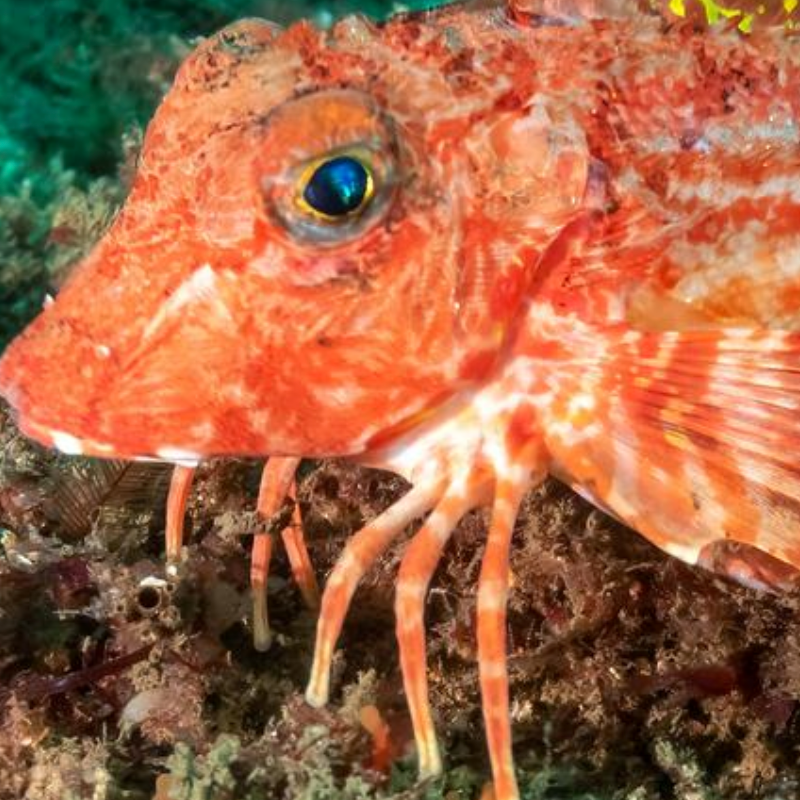

Yep. Sea robins are actual ocean fish—with leg-like appendages that make them adept at finding prey. (OK, sea robin's “legs” are extensions of their pectoral fins, of which they have three on each side.)
Corey Allard, a postdoctoral fellow at Cape Cod’s Marine Biological Laboratory, saw some sea robins in a tank "because they know we like weird animals,” Allard said in a statement.
Framework for evolutionary adaptations
The study led to a collaboration with Stanford researchers studying the fish’s developmental genetics, and to papers in Current Biology dealing with how sea robins use their legs, what genes control the emergence of those legs, and how these animals could be used as a conceptual framework for evolutionary adaptations.
The team also explored Prionotus carolinus, a fish that digs to find buried prey and are highly sensitive to touch and chemical signals; and P. evolans, which lack these sensory capabilities and use their legs for locomotion and probing, but not for digging.
How walking fish could teach us
The walking fish are a potentially powerful model organism to compare specialized traits, and to teach us about how evolution allows for adaptation to very specific environments, the team suggests. For example, there are genetic transcription factors that control the development of the sea robins’ legs that are also found in the limbs of other animals, including humans.
A second study, focused on genetics, included the Max Planck Institute in Germany and comprehensively examined the genetic underpinnings of the walking fish’s unusual trait. The researchers used techniques including transcriptomic and genomic editing to identify which gene transcription factors are used in leg formation and function in the sea robins. They also generated hybrids between two sea robin species with distinct leg shapes to explore the genetic basis for these differences.
Citation: Corey AH Allard, Amy L Herbert, Stephanie P Krueger, Qiaoyi Liang, Brittany L Walsh, Andrew L Rhyne, Allex N Gourlay, Agnese Seminara, Maude W Baldwin, David M Kingsley, Nicholas W Bellono. Evolution of novel sensory organs in fish with legs. September 26, 2024. Current Biology. https://www.cell.com/current-biology/abstract/S0960-9822(24)01126-6.
Citation: Corey AH Allard, Amy L Herbert, Stephanie P Krueger, Qiaoyi Liang, Brittany L Walsh, Andrew L Rhyne, Allex N Gourlay, Agnese Seminara, Maude W Baldwin, David M Kingsley, Nicholas W Bellono. September 26, 2024. BioRxiv. https://www.biorxiv.org/content/10.1101/2023.10.14.562285v1 (preprint, open-access)