
A new artificial intelligence (AI) model helps predict results of fusion power tests, which could make this technology come faster, SingularityHub reports. Nuclear fusion could release huge energy, but it needs extreme conditions, making reactors hard to design and run. Simulations of these processes usually take a lot of time on supercomputers and are not always accurate.
Ai is speeding up progress here. In 2022, Google DeepMind trained a model to control the hot plasma, a super-heated gas of charged particles, in a fusion reactor. Now, scientists at the US National Ignition Facility have used AI to feel sure about their success before a key experiment. In a paper published in Science, they describe a generative machine learning model that predicted a 74 percent chance the test would produce more energy than it used. This accurate forecasting can help plan new tests and decide on hardware changes.
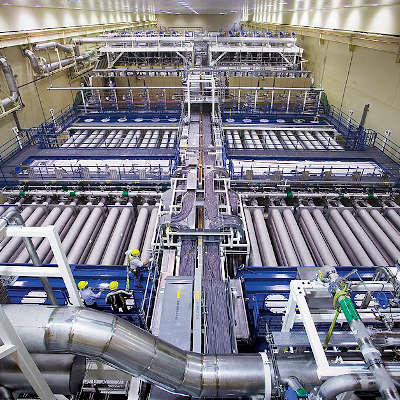
The National Ignition Facility uses inertial confinement fusion, where powerful lasers hit a tiny capsule of hydrogen isotopes to make it implode and cause fusion. In one test, lasers put in 2.05 megajoules of energy, a unit of energy measurement, and got out 3.15 megajoules, marking the first net energy gain.
How the model combines data and AI
These tests cost a lot, so good predictions are useful. The model uses Bayesian inference, a statistical method that gives probability-based forecasts, on data from past tests. To add more info, since real tests are few, researchers trained a deep neural network on 150,000 simulations. This creates a model informed by both real and simulated data to predict how design changes affect results.
Older methods tweak physics simulations to match past data but struggle with big changes. This new way handles them better. It raised success odds from 0.5 percent in the prior setup to 74 percent. The approach fits the facility's unique setup but can adapt to other tough problems with limited data. Researchers are already using it to boost energy outputs in ongoing fusion work.
Earlier this month, LLNL scientists combined AI with fusion target design by deploying AI agents on two of the world’s most powerful supercomputers to automate and accelerate inertial confinement fusion experiments at NIF.