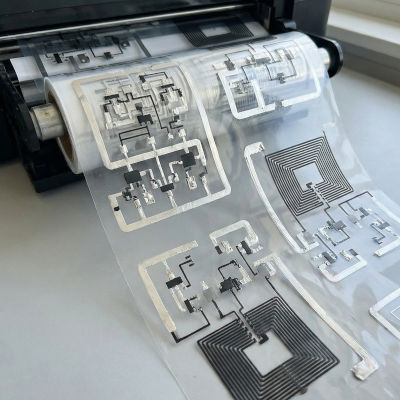

Researchers have achieved a breakthrough that significantly advances the ability to produce cheap, printable electronics. This development brings society closer to manufacturing items such as wearable health sensors and flexible display screens using methods similar to printing a newspaper. The scientists involved have solved a long-standing problem regarding how layered materials behave. This solution provides a universal rule to predict the future of the two-dimensional semiconductor industry.
Previously, finding the right materials to build these devices was largely a process of trial and error. Scientists did not understand why some materials could successfully undergo electrochemical exfoliation while others could not. Electrochemical exfoliation is a technique where an electrical current forces ions into a solid material. This weakens the forces holding the material together and separates it into ultra-thin layers known as nanosheets. The researchers discovered that the key to success lies in the physical stiffness of the material - how much it resists deformation when pressure is applied. The research indicates that for a material to exfoliate properly, its "in-plane stiffness," or resistance along the flat layer, must be higher than its "out-of-plane stiffness," which is its resistance perpendicular to the layer.
Using inks to print computer circuits
By applying this new rule, the group was able to identify the specific thresholds required for success. This allowed them to unlock dozens of new semiconductor materials that can be turned into liquid inks. They have already used these inks to print working transistors. They also created more complex components, such as digital-to-analogue converters and communication circuits capable of encoding messages.
The study revealed that the performance of these printed devices is currently limited by the junctions between the individual semiconductor flakes, rather than defects within the flakes themselves. Future work will focus on improving these connections to increase speed and efficiency. This research suggests a future where abundant, low-cost, and high-performance electronics are manufactured rapidly using solution-processed materials.
This research work is described in a paper published in Nature Communications.