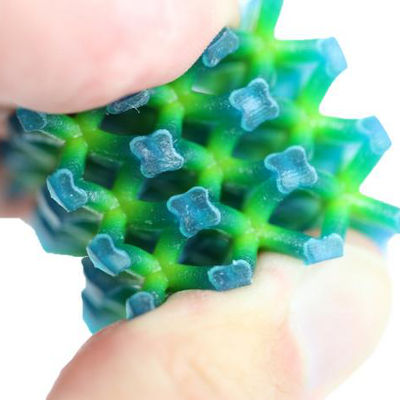

Researchers at UC Boulder have developed a new software called OpenVCAD. This tool lets engineers use code and functions to design not just the shape of a 3D object, but also where different materials go inside it. Additive manufacturing, which is a way to build objects layer by layer using 3D printers, often needs this kind of detail for complex items. A paper to be published in Additive Manufacturing shows how OpenVCAD can change how people design things with many materials.
Traditional computer-aided design (CAD) software usually treats everything inside an object's outer surface as the same material. This makes it hard to create gradient designs, where materials blend slowly from one type to another, like a shoe bottom that goes from hard to soft. OpenVCAD fixes this by letting users write simple code to set up these blends easily. It acts like a set of helpful tools that make complex designs quick to change - just tweak one part of the code, and the whole object updates.
Pushing boundaries in multi-material work
Unlike old CAD tools that require drawing every detail by hand and can't handle smooth material changes, OpenVCAD is the first widely available code-based system for this. It's open-source, and it works with Python,. Users can import it with one line of code and start designing.
The software works with different 3D printers, even ones that handle up to five materials at once. It has broad uses: surgeons can make practice models with realistic soft and hard parts; robotics experts can build flexible parts that bend in specific ways; engineers can create files ready for simulations, which are computer tests of how objects behave. It even lets users set different strengths in lattice structures, which are lightweight frameworks good for absorbing shocks.
The researchers hope OpenVCAD helps more people in many fields. It's already used by researchers elsewhere, and they want it to grow so engineers can do better work without starting from scratch each time.