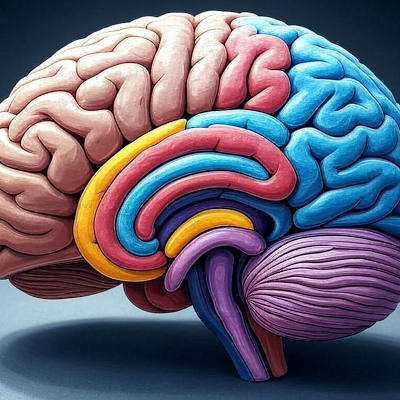

Keith Hengen, a biology professor at Washington University in St. Louis, has proposed a new way to understand how the brain functions, with ideas that could help prevent Alzheimer’s disease and other brain disorders. In a paper published in Neuron, Hengen suggests that the brain’s power comes from a simple set of mathematical rules. He believes that almost everything the brain does, like reading or driving, is learned through experience rather than being preprogrammed at birth. For the brain to learn effectively, it must be in a special state called criticality, a term from physics that describes a system balanced between order and chaos, ready to take in new information.
Hengen worked with Woodrow Shew, a physicist, to develop this idea. They explain criticality using the example of a sand pile: as sand is added, the pile grows steeper until it’s on the verge of collapsing. At that moment, it’s in a critical state, perfectly balanced. In the brain, criticality means neurons, which are nerve cells that transmit information, are primed to learn and process information efficiently. This state is measurable using fMRI, a brain imaging technology that shows brain activity. The researchers say criticality is the brain’s optimal state for thinking, remembering, and learning, and it stays consistent whether looking at a few neurons or a whole brain region.
A new understanding of brain diseases
The idea of criticality also offers a fresh perspective on brain diseases like Alzheimer’s. Hengen suggests these diseases disrupt the brain’s ability to stay in this critical state, making it harder to process information. In Alzheimer’s, for example, a protein called tau builds up and breaks the brain’s ability to maintain criticality, leading to memory problems. This explains why symptoms often appear late, as the brain compensates for damage until criticality is lost. Using fMRI, doctors might detect these changes early, allowing for earlier treatment. Hengen also found that sleep helps restore criticality, and poor sleep increases Alzheimer’s risk. Studies with mice show that improving sleep can enhance learning in those with Alzheimer’s symptoms, suggesting sleep therapies could help humans too.