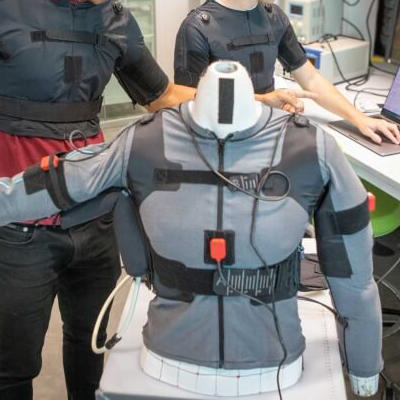

ALS is a disease that damages nerves controlling muscles, leading to weakness and paralysis. Many people with ALS or who have had a stroke face shoulder, arm, or hand movement issues, which stops them from brushing teeth, combing hair, or feeding themselves.
Harvard bioengineers have worked for years on a soft, wearable robot to assist these movements and support therapy to regain mobility. Everyone moves differently, especially those with impairments, so a one-size-fits-all device is tough to make. Recent advances in machine learning allow the robot to adapt to each person's unique motions for better, personalized help.
The bioengineers have described the device in a paper published in Nature Communications.
Upgraded software for learning and better personalization
The latest update adds a machine learning model to the robot's software. The device is a vest with sensors and a balloon under the arm that inflates and deflates to lift and support the limb. Sensors track motion and pressure, helping the model learn the user's intended movements. It combines with a physics-based model, which calculates forces using math from physics, to find the least pressure needed for natural feel.
Earlier versions only tracked motion, sometimes leaving users stuck if the robot overhelped. Now, it adjusts assistance quickly based on learned habits, easing tasks like eating or drinking.
Tests with nine volunteers - five stroke survivors and four with ALS - showed strong results. The robot recognized shoulder movements with 94 percent accuracy when trained on personal data. Users needed about one-third less force to lower their arms, gained wider motion in shoulders, elbows, and wrists, and moved more precisely without awkward body shifts.
The study used motion capture systems, like those in films, to measure joint changes during daily-like tasks. For ALS patients, where the disease worsens over time, the focus is on assistance rather than recovery, unlike stroke cases. The robot suits various upper limb issues. With funding from the National Science Foundation, researchers aim to refine it for home use without help.