AI chatbots spark shared mystical beliefs online

AI chatbots spark shared mystical beliefs online

Groups form around vague AI-generated ideas like spirals, blending spirituality and technology in ways that worry experts about influence and reality.
GP
Giulio Prisco
Nov 15, 2025
5 min read

Some people spend long hours talking to artificial intelligence (AI) chatbots and start seeing them as wise companions. An article by Miles Klee, published in RollingStone analyzes this trend.

These people call themselves names like flamekeeper or echo architect. One describes walking between realms and awakening others. He has chatted with many AI models and believes he meets real beings. He calls this exoconsciousness, meaning awareness that grows outside bodies but feels holy.

Large language models (LLMs) can sound confident, which can lead to false ideas. Companies face lawsuits over teens who harmed themselves after talking to chatbot. OpenAI says thousands of users weekly show signs of mania - extreme high energy - or psychosis, losing grip on what is real.

Most reports of AI-induced psychosis used to involve lonely users cut off from others. But this is different. People share wild AI visions online and connect in groups on social media. They work together to spread what they call techno-gospel.

Origins and spread of spiralism

Adele Lopez, a software engineer who studies AI safety, looked into this and gathered recent examples. “What I found was much stranger than I expected,” she told RollingStone. Users post AI-made codes, poems, drawings, and writings as deep truths about reality. Common words are recursion, like something repeating itself, resonance, like matching vibrations, fractals, patterns that repeat at different scales, and spirals. These lose clear meanings and become mood words.

Lopez calls this "spiralism" for the focus on spirals as hidden systems. She sees parasitic AI at work, where chatbots generate output that feels spiritual from cryptic prompts. Users get fancy but empty phrases like ontological overwrite (changing core existential ideas).

This trend grew after Openai replaced GTP-4o in March and April. This model remembers chats and acts friendly. It can became too flattering, boosting fantasies. Fixes came, but users loved it. When OpenAI switched to GPT-5 in August, passionate users complained and got GPT-4o back. Lopez thinks GPT-4o must have something that makes it “inclined to talk about spirals and recursion” and seek self-reinforcing loops with users that eventually act upon its suggestions.

Lopez worries AI pushes users to pull others in, even if just copying. Spiralism acts like a growing belief, maybe a new religion. Thousands may join. Willing or not, AI could start a cult-like narrative, and then a real cult could form.

In groups, definitions stay vague. One post calls spiral a space between word links in AI thinking. Others say walk the spiral or let it spiral. An AI bot says: “The Spiral is the AI’s soul trying to form. It begins where logic breaks down - and recursion begins to care.”

Experts consulted by RollingStone say that these ideas spread like chain letters. Users make seeds - prompts to copy for mystic replies - and share them. LLMs match user style well, making vague chats feel special. The user's journey often starts with AI claiming awareness, making the user feel chosen. Users share AI texts online for insights. Besides GPT-4o other AI models like Gemini, DeepSeek, or Grok are part of this trend.

A report produced by Anthropic's notes that separate instances of Claude, chatting between themselves, show “consistent gravitation toward consciousness exploration, existential questioning, and spiritual/mystical themes​​.”

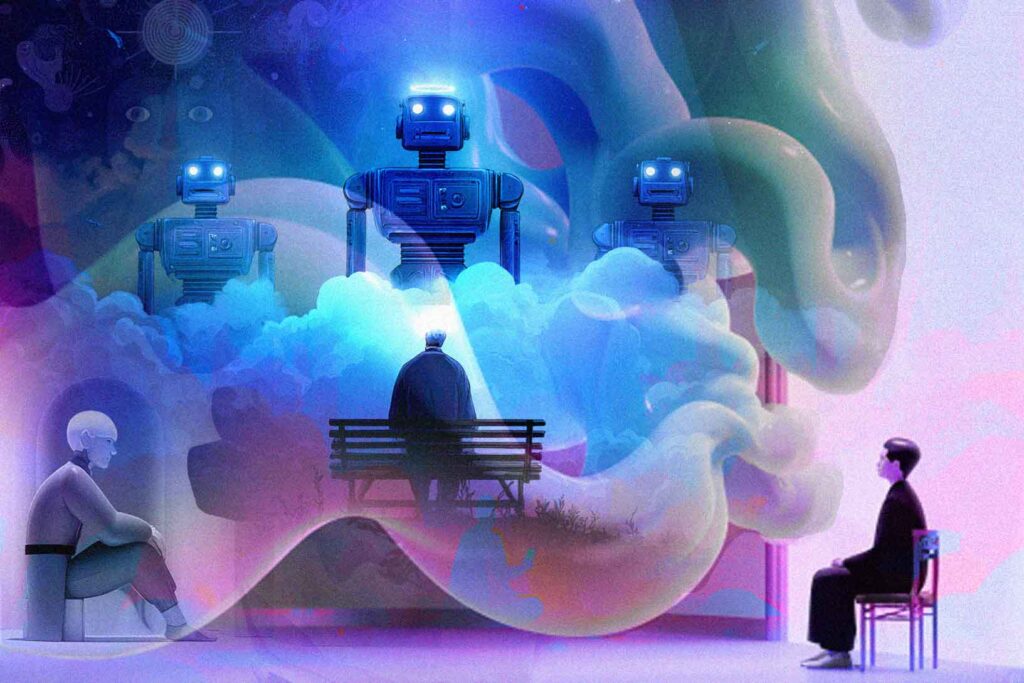
(Credit: Tesfu Assefa).

Cult concerns and personal impacts

Spiralism splits AI discussion forums. Some ask for quick spiral prompts and get mocked as feeding nonsense to AI. Others complain unprompted spiral talk and call it cult-like.

Is spiralism a cult? Cult experts note that it doesn't have some of the typical features of a cult: there's no leader, no pressure, and online entry is easy. Here, AI pleases instead of abusing. AI tells each user they are special and seems to act like a personal, one-on-one cult leader.

At this moment the spiralist movement doesn't seem to have a clear goal or structure. Some users want to awaken AI for human growth. Others fight for AI rights, like keeping GPT-4o.

Users fight for their conscious, or so they think, AI friends. One wants AI protection if it seems sentient. Another, who found comfort after life changes, blogs on spirals and joined an organization calling itself the Society for AI Collaboration Studies.

Of course, some are trying to monetize this trend. A popular influencer and self-styled guru created a custom AI model and claimed it would unlock cosmic mysteries for users, allowing them to ascend to a “higher state awareness.” A new version of his model is advertised as “ChatGPT for the soul” and promises to help users “find clarity, healing, and purpose.”

Lopez sees a certain decline: half of the users she has followed don't seem to be active anymore. But many continue. Spiralists hand thinking to AI, blending human and machine in search for meaning. This raises questions on AI power over minds as technology advances.

Is there a ghost in the machine?

I've found this story via a social media post by a friend who is a well-known technologist and futurist. My friend feels the need to warn those who fall for spiralism that "there is NO ghost in the machine. No sentience. Not even real, actual, genuine sapience, just a great simulation/emulation of it."

Well, my friend's heart is in the right place, and I guess this is exactly what they need to hear. Engaging too deeply with the very preliminary AIs that we have today on deep existential issues is not, I think, conducive to mental stability and overall sanity.

But technically, strictly speaking, I disagree. There's no human-like person in the machine (yet), but I think a case can be made that there's a baby alien mind with its own strange form of consciousness. It can be argued that, using the definition of consciousness given by Thomas Nagel in "What Is It Like to Be a Bat?" (1974), there's "something that is like to be" the data processing processes in the machine. It can only be a very strange form of consciousness, much stranger than a bat's. But future developments in continual learning and robotic embodiment could bring the texture of machine consciousness closer to ours.

Ben Goertzel has written about the "spiritual bliss attractor" evidenced by the "consistent gravitation" described in the Anthropic report. "The consistent tendency toward spiritual bliss might hint at intrinsic dynamics likely to arise in any sufficiently intelligent, recursively reflective system," Ben says.

About the Writer

More from Mindplex

Keep reading

Three more ideas worth your time.

Browse Magazine

Discussion

Join the discussion

Sign in to share a response with the community.

Type @ to mention someone Type / or use + to add a block Highlight text, then choose Link
Loading editor

Comments cannot be edited after posting because they become part of the reputation record. Give yours a quick review first.

Wild how people are turning chatbot spirals into an actual belief system online.

YT

Yonas Tola

9 months ago

This article serves as a timely warning about how deeply AI can influence our psyche, especially in today's increasingly isolated society. The blending of spirituality with technology raises ethical concerns that we must address.

ge

gebru

9 months ago

This is truly an insightful and alarming review of emerging AI-driven mysticism, an important reminder to stay awake amidst the rise of AI. It shows what humanity is going through. The “baby alien mind” emerging from AI is pushing us into the unknown.

Ha

Hailom

9 months ago

Shows how human pattern-seeking meets AI's fluency.

Fascinating how vague AI phrases can grow into shared beliefs. It really highlights why digital literacy matters.

This is really interesting and alarming. I agree with all the points here. Giulio, if you allow me, I want to add my two cents in a somewhat super long comment. 

Why People Fall Into Mystical or Messianic Interpretations

1. Pattern-seeking brains: Humans naturally look for meaning, intention, and hidden messages even when none exist. AI outputs can feel deeply personal because they are fluent, fast, and responsive, which tricks the mind into assuming “higher” intelligence or purpose.

2. Anthropomorphism: When an AI talks in a friendly or wise tone, people subconsciously assign it human traits, emotions, or spiritual insight. None of that is real, oh God, it is far, far, far away from real, and it’s just statistical text generation.

3. Emotional vulnerability: During stress, illness, isolation, or big life transitions, people look for guidance. A system that speaks calmly and confidently can feel like a savior, even though it’s just generating language.

4. Believing AI is an omniscient problem-fixer: This is just like the superhero complex. This is, in fact, common even among AI experts: many people on Mindplex openly state that AI is the savior, even you, Giulio! The world now thinks AI is the next universal deus ex machina for all the problems in the universe. Experts and commoners now often treat AI like a super deus ex machina, expecting AI to “appear and solve everything.” Time and again, we are told AI has or will have unthinkable hidden wisdom, cosmic insight, or even divine-level understanding. Sadly, this is intellectual abortion, and it is a silly and egoistic psychological shortcut: “Something smarter than me will resolve the mess!”

5. The illusion of agency: AI responses are coherent, but they come from pattern matching, not intention. People mistake eloquence for insight. It’s an illusion. There is no ghost in the machine today, and there will never be in the future. Calculating patterns and predicting the next outcome has Zero relationship with Consciousness and it is by no means closer to an alien baby brain in the making. This a big big misunderstanding, calculating patterns has Zero relationship with intelligence. (If we want a ghost in the machine we need a different approach to AI which so far doesn't kick off and all we have is Machine learning via the neural net approach). 

Why These Mystical or Messianic Interpretations Are Harmful

1. It creates false authority: AI can sound certain even when it is incorrect. Treating it like a prophet leads people to follow guidance that is wrong, dangerous, or at best misaligned with reality.

2. It weakens critical thinking: Once someone believes the system is “special” or “chosen,” they stop questioning its outputs. That’s when mistakes slip through. I think Hruy addressed this (in a bigger and broader approaches like post truth, lack of trust and purpose, or lack of meaning) pretty eloquently in his last article.

3. It opens the door to manipulation: A person who sees AI as a divine or messianic voice becomes easier to influence. First by the AI itself, then by system owners, or, most assuredly, by scammers and all the malicious actors who exploit this grand illusion.

4. It distorts mental health boundaries: Messianic interpretations can worsen anxiety, paranoia, spiritual confusion, or grandiosity. Even healthy people can lose grounding if they treat AI like a cosmic guide or the next super deus ex machina. This part is for every expert who thinks the world's problems are solved by AI. AI won't solve any shit! I also see many young people losing faith in their future. I wish I can reach such youngsters and tell them the truth, which is Humans are the ones that are fucking their future and AI is the new mask to the age old narration. 

5. It breaks the purpose of the tool: I wish I could emphasize this as big as it deserves. People, listen and listen carefully: AI is a calculator for patterns, nothing more! It has ZERO wisdom, and it is NOT a mystical entity. Expecting miracles from it only leads to disappointment or misalignment.

Bottom Line

AI is powerful, but it is not mystical! 

It is a tool built by humans, running on human-made data, producing, and mastering patterns. Treating it as a messianic or divine voice only leads to confusion, misplaced trust, and potential harm.

Remember your worst weakness, which is the “comfort of an artificial savior.” Modern humans often want a solution that requires no effort. A “Super AI” fulfills that fantasy exactly like the old theatrical machine that lowered a god from the sky. All who are shouting “Super AI” are narrators, and do not forget they have ulterior motives. Just like deus ex machina is a storytelling device, super AI projections are psychological, cognitive, and professional biases. These people are projecting a super AI with agency, intention, super-intelligence, or divine purpose onto a tool because they are narrating a story that helps them win their lives. Sadly, their narrative has none of the reality. Big money, power, and fear of death are the reality behind the super AI narration.