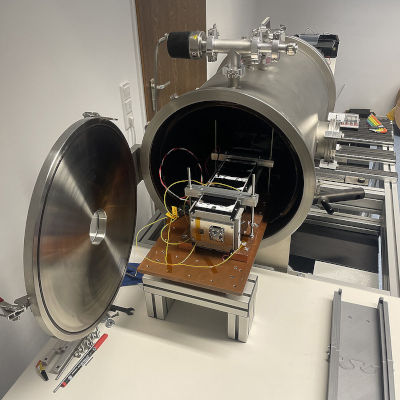

Researchers at the University of Würzburg have used an artificial intelligence (AI) system to control a satellite in space for the first time. This happened during a test on October 30, 2025, aboard the InnoCube, a small nanosatellite about the size of a shoebox. The AI managed the satellite's attitude by operating reaction wheels, devices that spin to rotate the satellite without using fuel. The AI successfully moved the satellite from its starting position to a target one, and repeated the task safely in follow-up tests.
The project, called LeLaR for "In-Orbit Demonstrator for Learning Attitude Control," focuses on creating advanced systems that can handle satellite stability on their own. Attitude controllers keep satellites from tumbling and help aim instruments like cameras or antennas at specific spots. What sets this apart is the use of deep reinforcement learning, a type of machine learning where the AI learns the best actions through trial and error in a simulated setting, like a virtual practice environment.
Bridging simulation to reality
A big challenge was closing the Sim2Real gap, the difference between how the AI performs in a computer simulation and in actual space conditions. The AI was trained on Earth using a detailed simulation, then uploaded to the satellite. It proved fast and flexible, unlike traditional controllers that need long manual adjustments by experts, sometimes taking months. This method automates tuning and can adapt to unexpected changes without extra work.
The success builds trust in AI for critical space tasks, especially for far-off missions where delays make human control hard. The work highlights potential for lighter, more reliable satellites using innovations like wireless data links instead of cables. Looking ahead, this could lead to fully autonomous spacecraft for deep-space exploration, making development quicker and cheaper. The results show AI can handle real maneuvers precisely, opening doors to smarter satellite designs.