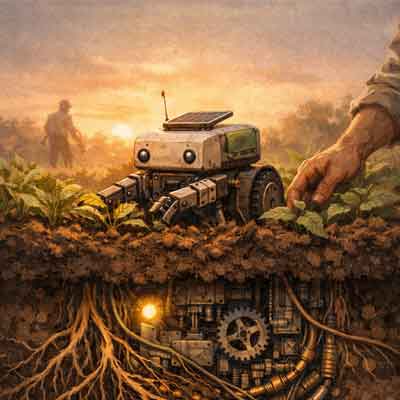

Low-cost agricultural robots are reshaping food security from the ground up, without headlines or hype.
The most transformative robots in agriculture are not humanoid, expensive, or intelligent in the ways Silicon Valley celebrates.
They are small, quiet machines doing repetitive work in fields where labor shortages, climate stress, and thin margins collide.
Global agriculture is under pressure from multiple directions at once. Climate volatility is disrupting planting cycles, labor availability is shrinking, and food demand continues to rise. For decades, automation promised relief, but its benefits largely bypassed small and medium-scale farmers.
What is changing now is not just technology, but cost. Advances in sensors, embedded computing, and mechanical design have pushed agricultural robotics into a new price bracket. These systems are no longer luxury assets reserved for industrial farms, but tools that can operate in regions with limited infrastructure and capital.
This shift sits at the intersection of robotics, AI-lite systems, and global food ethics. It raises a central tension: can automation strengthen food security without deepening inequality or displacing the very communities it aims to support?

From Precision Farming to Practical Automation
Early agricultural robotics focused on precision farming—GPS-guided tractors, drone surveillance, and data-heavy optimization. These systems delivered efficiency, but demanded capital, connectivity, and technical expertise.
Low-cost robots operate differently. They focus on narrow tasks: weeding, planting, soil monitoring, pest detection. Instead of replacing entire workflows, they insert themselves quietly into daily farm routines.
Why this matters: By lowering complexity and cost, automation becomes additive rather than disruptive, enabling adoption without systemic overhaul.
The Design Philosophy of Low-Cost Farm Robots
These machines are defined by constraint. Limited power, limited computation, and minimal sensors force designers to prioritize robustness over intelligence.
Many rely on rule-based navigation, simple vision systems, or mechanical guidance rather than deep learning. Failure modes are predictable. Repairs are often mechanical, not software-driven.
Why this matters: Resilience matters more than sophistication in environments where downtime directly threatens livelihoods.
Edge Intelligence Without the Cloud
Unlike industrial AI systems, low-cost agricultural robots operate almost entirely offline. They process data locally and react immediately to environmental cues.
This design choice is not a limitation—it is an adaptation. Connectivity in rural regions is unreliable, and cloud dependence introduces fragility.
Why this matters: Local intelligence aligns technology with real-world conditions rather than idealized infrastructure.
Labor, Not Replacement, but Redistribution
The dominant narrative around automation centers on job loss. In agriculture, the story is more nuanced.
These robots tend to replace tasks that are physically exhausting, repetitive, or time-sensitive. Human labor shifts toward supervision, planning, and maintenance rather than elimination.
Why this matters: Automation can rebalance labor rather than erase it, preserving human agency while reducing physical strain.
A Global South Innovation Loop
Some of the most creative deployments of low-cost agricultural robotics are emerging outside traditional innovation hubs. Constraints drive ingenuity.
Systems designed for small plots, irregular terrain, and mixed crops challenge assumptions baked into Western industrial farming models.
Why this matters: Innovation is no longer flowing in a single direction; local solutions are redefining global best practices.
Core mechanisms: Task-specific automation, mechanical guidance, basic computer vision
Key metrics: Cost per unit, uptime, task completion rate, maintenance frequency
Methods: On-device processing, modular hardware design, low-energy systems
Components: Microcontrollers, simple sensor arrays, electromechanical actuators
Low-cost agricultural robotics raises ethical questions precisely because it appears benign. When technology integrates quietly, oversight can lag behind deployment.
There is also the question of ownership. If farmers become dependent on proprietary machines they cannot repair or modify, technological inclusion may mask a new form of dependency.
At a deeper level, these systems challenge assumptions about progress. They suggest that the future of automation may not be defined by intelligence alone, but by alignment with human scale, local context, and ecological limits.
The robotics revolution reshaping agriculture is not loud, centralized, or glamorous. It is incremental, grounded, and deeply pragmatic.
As low-cost machines quietly transform how food is grown, the real question is not whether agriculture will automate, but whether this automation will remain human-centered—or drift toward the same concentration of power seen elsewhere.