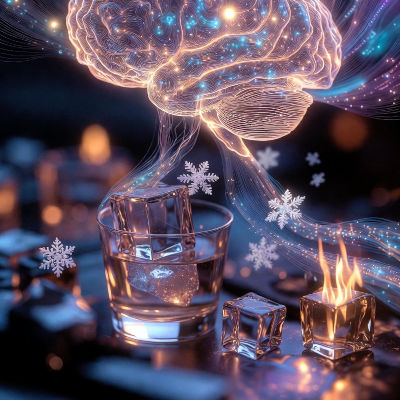

Artificial Intelligence (AI) language models can arguably develop a basic understanding of the real world. A new study from Brown University, published as arXiv preprint, examined whether these models go beyond matching patterns in text and actually grasp differences between everyday events, unlikely ones, impossible ones, and pure nonsense.
The researchers tested several open-source models, including versions of GPT-2, Llama, and Gemma. They presented sentences such as “Someone cooled a drink with ice” for commonplace events, “Someone cooled a drink with snow” for improbable ones, “Someone cooled a drink with fire” for impossible ones, and “Someone cooled a drink with yesterday” for nonsense. Instead of looking only at the output, the study used a method called mechanistic interpretability. This approach is like neuroscience for artificial intelligence: it reverse-engineers the internal mathematical states, or brain-like patterns, that the model creates when processing input.
The analysis showed that larger models form distinct internal vectors, which are mathematical patterns, for each category of event. These vectors separate even close categories, such as improbable versus impossible, with about 85 percent accuracy. The patterns also match human uncertainty. When people disagree on whether something is impossible or just unlikely, the models assign similar mixed probabilities.
Mechanistic interpretability reveals shared structure with human judgment
This internal structure emerges in models with more than two billion parameters, a size much smaller than today’s largest systems. The findings suggest that modern AI language models encode basic causal rules of the world in a way that aligns with how humans judge plausibility. Such insights from mechanistic interpretability could guide the creation of more reliable and trustworthy AI systems.
The work contributes to ongoing efforts to understand what AI actually knows rather than what it appears to say. By opening the black box of these models, researchers gain clearer clues about their strengths and limits.