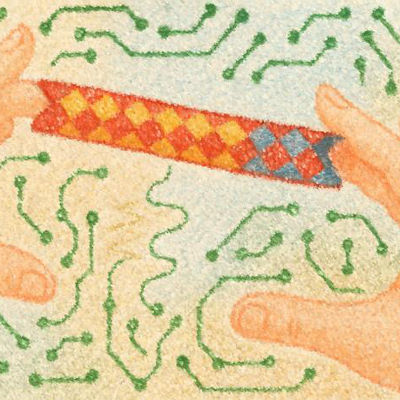

Some connections in nature behave like a Chinese finger trap: the harder they are pulled, the stronger they hold. These are known as catch-bonds, which are special links between proteins that strengthen under force. These bonds are vital for many biological processes, from helping bacteria stick to surfaces to keeping our body tissues from falling apart under stress. A key question has been whether these bonds need to be stretched to a certain point before they get stronger, or if their strengthening effect happens right away.
Researchers have now found an answer by studying cellulosomes, which are very strong protein structures found in some bacteria. They used molecular simulations - computer-generated movies that show how molecules move and behave. In these simulations, they applied a pulling force to the protein structures to see how they would stretch and eventually break. The information from hundreds of these simulations was then fed to an artificial intelligence (AI) system. This AI learned from data and was trained to predict when the bond would break. The AI was able to make accurate predictions using only the information from the very beginning of the pulling process. This showed that the catch-bond mechanism activates almost instantly when force is applied.
The significance of the discovery
Understanding how catch-bonds work is important because they are found throughout biology. For example, they help harmful bacteria resist being washed away from the body and allow our immune cells to grab onto blood vessel walls. This knowledge could help scientists design new materials, stronger medical adhesives, and even new medicines that work with mechanical forces instead of against them. The study also shows how powerful AI can be for understanding complex biological information. The AI was able to see subtle patterns in the molecules' movements that a person would likely miss. This combination of physics, biology, and AI, a field known as computational biophysics, opens up new possibilities for designing drugs and engineering new biological systems.
This research is published in Journal of Chemical Theory and Computation.