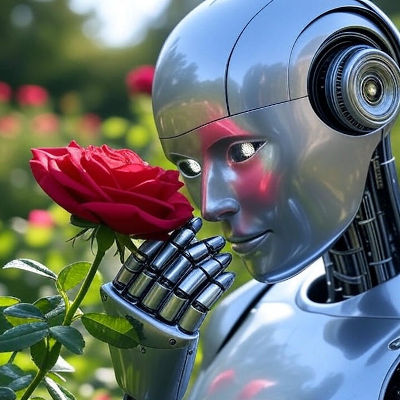

Artificial intelligence (AI) tools struggle to understand concepts like a flower the way humans do, according to a recent study. These tools rely on large language models (LLMs), and lack the ability to experience the world through senses like smell or touch, or through physical actions, which limits their understanding of certain concepts.
In a study published in Nature Human Behaviour, psychology researchers argue that without sensory experiences, such as smelling a rose or touching a daisy’s petals, these models cannot fully grasp what a flower represents to humans. This gap also applies to other concepts tied to human experiences. The findings suggest that because AI understands the world differently, it may interact with humans in ways that feel less natural or accurate.
Comparing human and AI understanding
To explore this, the researchers compared how humans and large language models represent 4,442 words, including concrete terms like “flower” and abstract ones like “humorous.” They tested two advanced model families from OpenAI (GPT-3.5 and GPT-4) and from Google (PaLM and Gemini). The comparison used two measures. The Glasgow Norms asked participants to rate words based on qualities like emotional arousal, which is how much a word stirs feelings, and imageability, which is how easily a word can be pictured mentally. The Lancaster Norms focused on how words relate to sensory experiences, like smell or vision, and motor actions, such as movements of the hand or torso.
The study found that language models performed well when representing words unrelated to senses or actions. However, they struggled with words tied to sensory or physical experiences, like those involving sight, taste, or touch. For example, humans link flowers to their scent, texture, and emotional impact, creating a rich, unified concept. Language models, relying mostly on text, cannot capture this depth. Even models trained with images performed better only for vision-related concepts, not for other senses or actions.
The researchers noted that language models require vast amounts of text - far more than humans encounter in a lifetime - yet still fall short in mimicking human understanding. While future advancements, such as incorporating sensor data or robotics, may improve their ability to represent human concepts, current models remain limited. The human experience, enriched by senses and actions, remains far more complex than what language alone can convey.