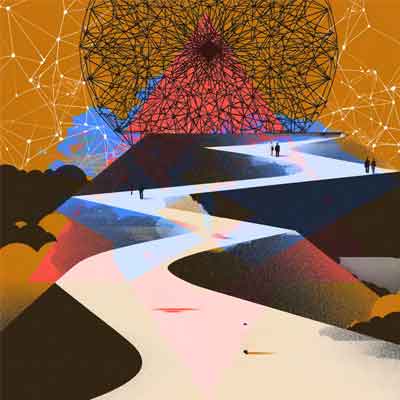

In an era where artificial intelligence tackles increasingly complex challenges, traditional methods often waste resources by pushing forward blindly or pulling backward inefficiently. Imagine an AI that navigates problems like a river flowing effortlessly downhill, finding the path of least resistance between uncertain starting points and desired outcomes. The vision drives geodesic inference control, a groundbreaking framework that unifies search, reasoning, and learning through minimal-effort pathways. The significance lies in its potential to make AI more scalable and reliable, especially as systems handle real-world uncertainty in fields like diagnostics and automation.
Core Geometry: Paths of Least Effort
Geodesic inference treats AI tasks as connections between probability distributions, where the start represents current knowledge and the goal encodes success criteria A probability distribution here spreads possibilities across candidates, such as initial hypotheses or pogram variants.
The researchers define the optimal connection as geodesic, the shortest path in a space shaped by Schrodinger-bridge geometry. This theoretical approach, rooted in optimal transport, minimizes effort by blending transport costs with penalties for straying from natural priors. Intermediate states gain priority from a product of forward reachability (ease from start) and backward usefulness (path to the goal), ensuring balanced progression.
This product rile emerges purely from theoretical analysis, providing a principled guide without experimental tuning.
Bidirectional Mechanics: Meeting in the Middle
The framework shines through bidirectional geodesic chaining, where frontiers expand simultaneously from start and goal. This strategy scores steps by the gain in combined reachability and usefulness per effort unit, while keeping effort density roughly constant to avoid spikes.
Practical approximations for guidance factors include factor-graph message passing for structured domains, short Monte Carlo rollouts for probabilistic estimates, or amortized learned functions for speed. When frontiers connect, they yield immediate valid paths with clear costs.
This dual expansion prevents stagnation common in unidirectional methods and supports anytime performance.
Real-World Impact: Logic and Evolutionary Domains
In probabilistic logic networks, the approach merges forward rule applications from premises with backyard drives from queries. Truth values track via Beta-like counts, with costs covering belief shifts, rule complexity, and evidence overlap. This yields concise, supported derivations.
For evolutionary program learning, it governs populations under edit operations, incorporating likelihoods, prior divergences, and diversity penalties. The bidirectional pull balances exploration and exploitation within budgets.
These instantiations demonstrate versatility across reasoning styles.
Safety Via Conservation: No Leaks or Fabrications
A generalized Noether theorem ties symmetries in effort to conserved quantities. Time-translation invariance preserves a charge analogous to energy, translating to evidence mass in logic or diversity in evolution.
This theoretical conservation forbids hallucinations (creating support) or double-counting (inflating via reuse), enforcing trustworthiness inherently.
Scaling Safely: Decentralized Evidence Handling
Implementation uses a local-first ledger with content-addressed objects, where evidence sketches and counts attach directly to data nodes. Merges across distributed parts subtract overlaps deterministically, using immutable records for convergence without central coordination.
Lightweight messages carry only references, aligning perfectly with bidirectional scoring.
This structure supports large-scale, concurrent systems.
Toward Effortless Intelligence
Geodesic inference control solves AI inefficiencies by casting tasks as least-effort distribution paths, powered by bidirectional chaining, conservation safeguards, and decentralized mechanics. This directly tackles the growing problem of resource waste and unreliability in complex systems, where flawed evidence propagation risks erroneous outputs in high-stakes applications. The need is clear: without principled efficiency, scaling AI invites brittleness. This study presents an actionable path forward. Developers should recommend integrating bidirectional geodesic elements into inference engines or evolutionary frameworks now to build verifiable, scalable intelligence.
References
Goertzel, Ben. “Geodesic Inference Cintrol: Rough Initial Draft.” December 5 2025
