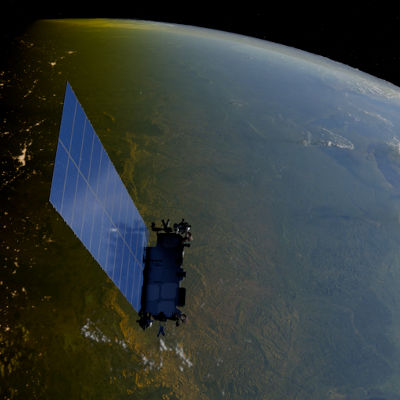

Many important services, like transportation and finance, rely on Global Navigation Satellite Systems, or GNSS, such as GPS, which is a system of satellites that sends signals to provide location, direction, and time data. These signals can be easily blocked by jamming, which is intentional interference, or tricked by spoofing, which is sending fake signals. As these problems grow worldwide, experts are looking for other ways to get reliable navigation information.
A recent study presented at the 43rd IEEE Military Communications Conference in Los Angeles explored using signals from satellites in low-Earth orbit, or LEO, which are closer to Earth than GNSS satellites and mainly provide internet access, like those from Starlink and OneWeb networks. Researchers found these signals could help ships navigate more accurately in hard areas like the Arctic, where GPS often works poorly due to weak coverage.
In a test off Greenland's west coast, a ship's navigation used LEO signals along with height data. Without GPS, errors were over a kilometer, but adding LEO data cut them to just 27 meters. This shows that listening to existing satellite signals could work almost anywhere on Earth. A press release notes that current options fail when GPS is lost, but this method uses what's already available.
Improving accuracy in tough regions
The work builds on earlier tests that used Starlink for positioning in various U.S. spots, from fixed points to moving vehicles and drones. For this Arctic trial, they chose the area because OneWeb satellites cluster near the poles, while Starlink covers other zones well. Researchers did not need help from satellite companies and only used public details on signal frequencies and rough locations.
LEO signals are much stronger than GNSS ones, making them harder for attackers to disrupt. This could boost safety in aerospace and defense, and reduce risks from cyberattacks on navigation, like those suspected in recent ship collisions and plane incidents. The approach is cheap and eco-friendly, avoiding new satellite launches, and could soon join future navigation systems for better security.