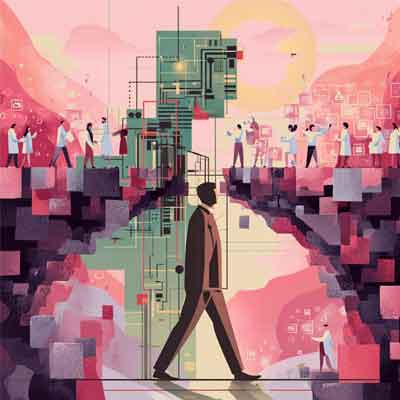

According to Oxford philosopher Toby Ord, the probability that humanity could face an existential catastrophe before 2100 is 1 in 6, roughly the equivalent of playing Russian roulette with the planet. The deeper problem is that we lack both the institutions and the political will to deal with it. We are living in what Ord calls “the Precipice”: a historical moment in which our destructive power is advancing far faster than our capacity to govern it wisely.
Alarm is no longer fringe
This level of concern is no longer unusual. The 2023 AI Impacts survey, which gathered responses from more than 2,700 AI experts, found that close to half assigned at least a 10% probability to advanced AI causing human extinction. Geoffrey Hinton has put that risk at between 10% and 20%, a figure Elon Musk has echoed in his own way. For their part, Sam Altman, Dario Amodei and hundreds of researchers have argued that mitigating extinction risk from AI should be a global priority on a par with pandemics and nuclear war. These are not apocalyptic theorists; they are the people building the technology itself.
Concern now extends well beyond Silicon Valley. The WEF’s Global Risks Report 2025, which draws on the views of 900 experts, points to an especially turbulent decade through to 2035, with deterioration across all 33 major risks it tracks.reports. This year, scientists are preparing a third warning to humanity, following those issued in 1992 and 2017, even as many of them doubt that anyone will listen.
The psychological trap
Disaster psychology has shown for years (from the classic work of Quarantelli to the more recent research of Drury) that human beings often cooperate surprisingly well in local emergencies. But once a threat becomes global and abstract, diffusion of responsibility kicks in. We assume, more or less unconsciously, that because the problem belongs to everyone, someone else will deal with it.
Getting past that blockage requires at least three things. First, a shared identity at a global level, something current geopolitical polarisation is steadily eroding. Second, a shift from diffuse responsibility to assigned responsibility: at present, less than 0.001% of global GDP goes towards preventing existential or civilisation-level collapse risks. And third, plain speaking. Institutional silence merely reinforces the cognitive biases that keep us standing still.
A precedent for survival
There is, however, one precedent worth keeping in mind. Around 900,000 years ago, humanity’s ancestors were reduced to barely 1,280 breeding individuals. They remained close to extinction for roughly 117,000 years, yet somehow came through it. If those ancestors survived their own abyss without technology or a roadmap, we (who understand the scale of ours perfectly well and share their genome) ought to be capable of organising ourselves.
By Eduardo Costas and Eduardo Martínez de la Fe. Eduardo Costas is Professor of Genetics at the Universidad Politécnica de Madrid, and Eduardo Martínez is Senior Editor at Futuribles.
This article is republished from Futuribles. Here's the original article in Spanish and English.