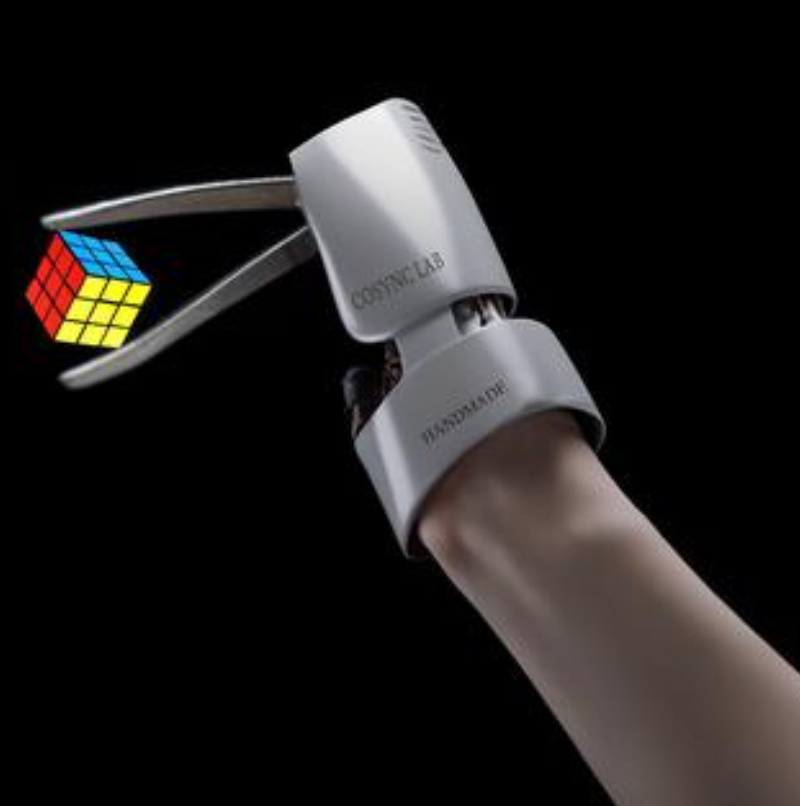

To explore this idea, researchers used virtual reality to test whether humans can feel embodiment in prosthetic “hands” resembling a pair of tweezers.
In the journal iScience, they report that participants felt an equal degree of embodiment with tweezer hands. They were also faster and more accurate in completing motor tasks in virtual reality than when they were equipped with a virtual human hand.
Merging with tools
“For our biology to merge seamlessly with tools, we need to feel that the tools are part of our body,” says first author and cognitive neuroscientist Ottavia Maddaluno in a statement.
“Our findings demonstrate that humans can experience a grafted tool as an integral part of their own body." Maddaluno and a team conducted the work at the Sapienza University of Rome and the Santa Lucia Foundation IRCCS.
Tweezers vs. native hand
To investigate this possibility, the researchers conducted a series of experiments in VR with healthy participants. They had either a human-like hand or a “bionic tool” resembling a large pair of tweezers grafted onto the end of their wrist.
For example, participants were asked to pop bubbles of a specific color by pinching them with either their tweezers or between their index finger and thumb. Result: participants were faster and more accurate at popping virtual bubbles when they had tweezer-hands.
Next, the team used a “cross-modal congruency task” to compare implicit or unconscious embodiment for the virtual hand and bionic tool. During this test, the researchers applied small vibrations to the participants’ fingertips and asked them to identify their stimulated fingers.
At the same time, a flickering light was displayed on the virtual reality screen, either on the same finger as the tactile stimulus or on a different finger.
By comparing the participants’ accuracy and reaction times during trials with matched and mismatched stimuli, the researchers could assess how distracted they were by the visual stimulus.
Simplicity rules
There was a bigger difference between matched and mismatched trials when participants had tweezers rather than human hands, indicating that the non-anthropomorphic prosthesis resulted in an even greater sense of embodiment.
The researchers speculate that this is due to the tweezer-hands’ relative simplicity compared to a human-like hand, which might make it easy for the brain to compute and accept.
The researchers also note that this could relate to the “uncanny valley” hypothesis since the virtual human hands might have been too eerily similar yet distinct for perfect embodiment.
Robotics and prosthetic limbs
The researchers say that this study could inform robotics and prosthetic limb design. “The next step is to study if these bionic tools could be embodied in patients that have lost limbs,” says Maddaluno. “And we also want to investigate the plastic changes that this kind of bionic tool can induce in the brains of both healthy participants and amputees.”
This research was supported by the European Research Council.
Citation: Matteo Marucci et al. June 6, 2024. Rewiring the evolution of the human hand: How the embodiment of a virtual bionic tool improves behavior. iScience https://doi.org/10.1016/j.isci.2024.109937 (open access)