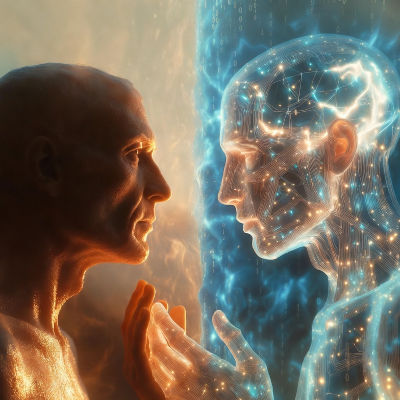

A new study from UC San Diego offers a clear scientific proof that modern artificial intelligence can pass the Turing test. The Turing test is an experiment proposed in 1950 by the British mathematician Alan Turing. It checks whether a machine can carry on a conversation so naturally that a person cannot reliably tell the machine from a real human.
In the tests, each participant chatted by text with two different partners at the same time. One partner was a real human and the other was an artificial intelligence (AI) system. After the conversation, the participant guessed which partner was the human. The researchers used several large language models.
One advanced model was judged to be human 73 percent of the time, which was more often than the real human partners. A second model reached 56 percent, matching the rate for humans. Older and simpler systems were chosen as human only about 20 to 23 percent of the time.
The role of specific instructions
The artificial intelligence systems performed best when given detailed instructions called persona prompts. These prompts told the models to act with a certain personality, tone, humor, and even human-like mistakes. When the models did not receive these instructions, they were much less convincing and were rarely mistaken for humans. The study authors suggest that the Turing test should be reinterpreted as measuring not intelligence, but humanlikeness.
The study authors explain that the artificial intelligence succeeded by copying social behaviors rather than by demonstrating superior knowledge. The conversations lasted five or fifteen minutes. Nearly 500 people took part, including university students and members of the general public. The results suggest that it is becoming harder to know if one is talking to a human or to artificial intelligence online. This situation raises questions about trust and the risk of deception in digital communication.
A paper published in PNAS describes the methods and results of this study.