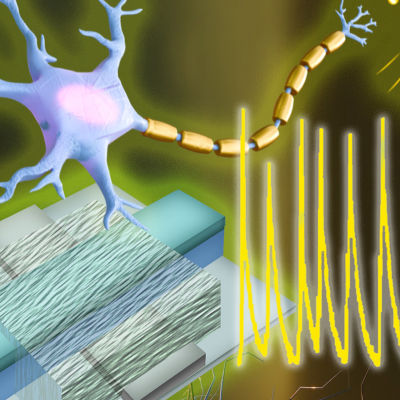

Engineers at the University of Massachusetts Amherst have developed an artificial neuron that works electrically like natural ones. Neurons send and receive electrical signals to process information. This new device could help build computers that are much more efficient and even link directly with living cells.
The human brain handles huge amounts of data using very little power, about 20 watts, which is like a dim light bulb. In contrast, large language models (LLMs) can use over a million watts for similar work. The brain's efficiency comes from its low-voltage signals, around 0.1 volts. Past artificial neurons needed much higher voltage, up to 10 times more, making them power-hungry and unable to connect safely with real neurons.
The new artificial neuron matches the body's low voltage, solving this issue.
Potential uses and key ingredient
This low-power design opens doors to redesigning computers based on biological ideas, making them far less energy-intensive. It could also create wearable sensors that read body signals without extra electrical boosting, which currently adds complexity and wastes power. These sensors would be simpler and more efficient for health monitoring.
The main part of this neuron is a protein nanowire, a tiny thread-like structure made of protein that conducts electricity. It comes from Geobacter sulfurreducens, a type of bacteria that naturally produces electricity. The engineers have used these nanowires before to make other efficient devices. For example, they created a biofilm, a thin layer of living material, powered by human sweat to run small electronics. Researchers also built an electronic nose, a sensor that detects smells to spot diseases, and a device that pulls electricity from moisture in the air, working with almost any material.
This research work is published in Nature Communications. It shows how bacteria-inspired tech could transform electronics and health tools by copying nature's low-energy ways.