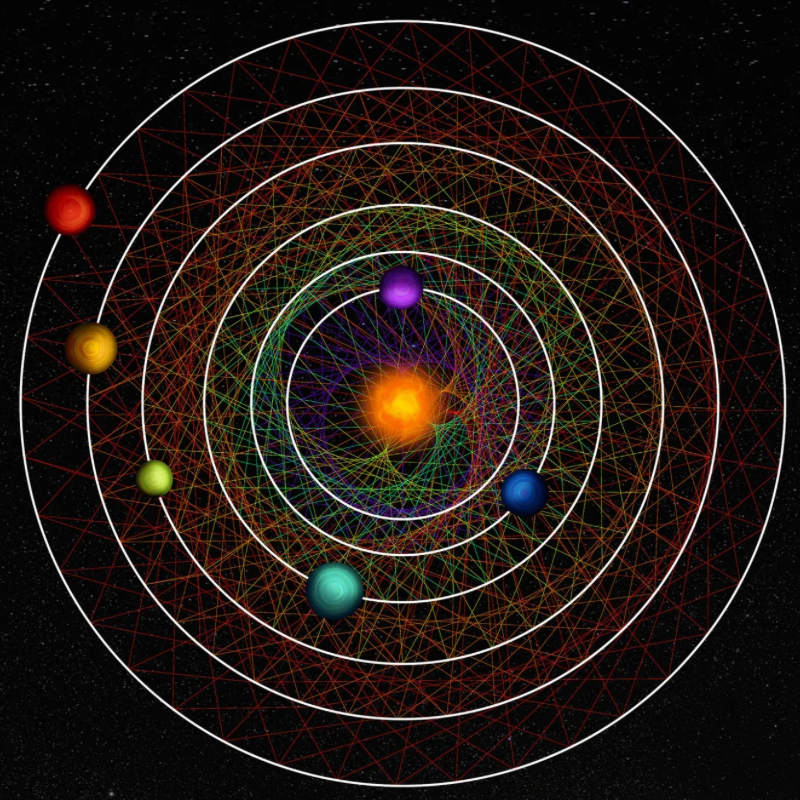

Astronomers have discovered six planets that orbit the bright star HD 110067 with a rhythmic beat, a rare case of an “in sync” gravitational lockstep that could offer "deep insight into planet formation and evolution," according to NASA.
An international team of astronomers, led by Rafael Luque, of the University of Chicago, published a paper online on the discovery, “A resonant sextuplet of sub-Neptunes transiting the bright star HD 110067,” in the journal Nature on Nov. 29.
Precise musical patterns
The strange family of six "sub-Neptune" planets (possibly smaller versions of our own Neptune) is moving in a cyclic rhythm. "This orbital waltz repeats itself so precisely it can be readily set to music," notes NASA.
"The planet closest to the star makes three orbits for every two of the next planet out—called a 3/2 resonance, a pattern that is repeated among the four closest planets." A pattern of four orbits for every three of the next planet out (a 4/3 resonance) is repeated twice.
"And these resonant orbits are rock-solid: The planets likely have been performing this same rhythmic dance since the system formed billions of years ago.
This animation shows six “sub-Neptune” exoplanets in rhythmic orbits around their star, with a musical tone as each planet passes a line drawn through the system. The line is where the planets cross in front of (“transit”) their star from Earth’s perspective. In these rhythms, known as “resonance,” the innermost planet makes three orbits for every two of the next planet out. Among the outermost planets, a pattern of four orbits for every three of the next planet out is repeated twice. Animation credit: Dr. Hugh Osborn, University of Bern
Citation: Luque, R., Osborn, H. P., Leleu, A., Pallé, E., Bonfanti, A., Barragán, O., Wilson, T. G., Broeg, C., Cameron, A. C., Lendl, M., Maxted, P. F., Alibert, Y., Gandolfi, D., Delisle, J., Hooton, M. J., Egger, J. A., Nowak, G., Lafarga, M., Rapetti, D., . . . Zingales, T. (2023). A resonant sextuplet of sub-Neptunes transiting the bright star HD 110067. Nature, 623(7989), 932-937. https://doi.org/10.1038/s41586-023-06692-3