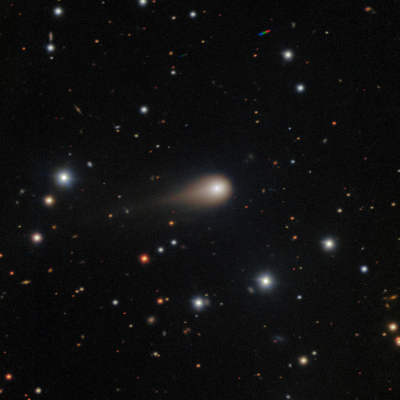

In a recent post, Harvard astronomer Avi Loeb comments on his recent Fox News interview and critiques comet experts who quickly labeled the interstellar object 3I/Atlas as a typical water-rich comet.
Loeb compares their approach to AI systems limited by training data, which for decades has consisted only of solar system icy rocks. He urges expanding this dataset to include human-launched technological objects, like the Tesla Roadster mistaken for an asteroid in January 2025 before being reclassified.
Loeb posits that advanced extraterrestrial civilizations could have sent artifacts across the Milky Way over billions of years, given the galaxy's age and the potential for billions of habitable planets. Probes like Voyager demonstrate how technology can traverse vast distances. He questions whether experts, trained solely on natural comets, would recognize such artifacts.
12 interesting anomalies
To support his view, Loeb lists 12 anomalies in 3I/Atlas that deviate from known comets: retrograde trajectory aligned closely with the ecliptic plane (0.2% likelihood); persistent sunward jet not explained by optical illusions; unusually massive nucleus moving faster than predecessors 1I/'Oumuamua and 2I/Borisov (<0.1% likelihood); trajectory fine-tuned to pass near Mars, Venus, and Jupiter, unobservable from Earth at perihelion (0.005% likelihood); gas plume with high nickel-to-iron ratio, resembling industrial alloys, and low cyanide (<1% likelihood); only 4% water content, unlike typical comets; extreme negative polarization, unprecedented (<1% likelihood); origin direction near the 1977 "Wow! Signal" (0.6% likelihood); rapid brightening near perihelion, bluer than the Sun; jets requiring implausibly large surface area for ice sublimation; non-gravitational acceleration implying 13% mass loss, yet no breakup observed; collimated jets maintaining orientation despite rotation.
Loeb laments that ignoring these misses public engagement opportunities, as science as "work in progress" excites people more than finalized claims. He criticizes the 2020 Decadal Survey's focus on microbial life searches, advocating balanced funding for technological signatures, which could be easier to detect and more publicly appealing.
He concludes that interstellar objects like 3I/Atlas offer chances to sample potential alien biology or technology, urging missions like OSIRIS-REx to retrieve samples.