
People with severe paralysis, such as from amyotrophic lateral sclerosis (ALS, a disease that destroys nerve cells controlling muscles) or cervical spinal cord injury, often lose the ability to speak or move their hands. This makes communication very difficult. Current options like eye-gaze systems, which track eye movements to select letters one by one, are slow and frustrating for many users.
A new study describes an investigational implantable brain-computer interface (iBCI, a device that reads brain signals and turns them into actions) designed to restore faster and more accurate typing.
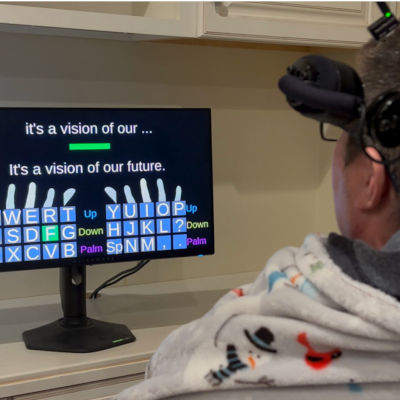
The device, developed through the BrainGate clinical trial, uses microelectrodes placed in the motor cortex (the brain area that plans and controls movement). These sensors detect electrical activity when a person imagines moving their fingers. A standard QWERTY keyboard appears on a screen, with each key linked to a specific finger position, such as up, down, or curled. As the user mentally attempts these finger movements, the system captures the brain signals, translates them into cursor actions on the keyboard, and then uses a predictive language model (artificial intelligence that guesses likely next words) to improve accuracy and speed.
Two participants tested the device at home. One had advanced ALS and the other had a spinal cord injury. After short calibration with only about 30 sentences, one achieved a peak typing speed of 110 characters per minute (about 22 words per minute) with just a 1.6% error rate. This accuracy matches typical typing by people without disabilities.
Promising step toward broader restoration
The approach shows strong potential for everyday home use. Researchers note that decoding imagined finger movements could also help restore more complex arm and hand actions in the future. Improvements, such as customized keyboards inspired by fast shorthand typing methods, may increase speed even more. This work combines advances in neuroscience and artificial intelligence (AI) to help return independence and communication to people with paralysis.
This research is published in Nature Neuroscience.