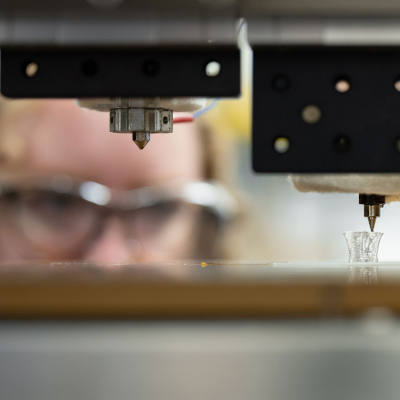

Princeton engineers have used thermoplastic elastomers to make soft 3D printed items with adjustable stiffness. Thermoplastic elastomers are polymers that can be melted and molded but turn elastic when cooled.
The engineers can control where the material is stiff or stretchy by changing how the 3D printer lays down the plastic. This technique could be useful for making soft robots, medical devices, helmets, and shoe soles.
The engineers have described the methods and results of this study in a paper published in Advanced Functional Materials.
The secret behind this material's versatility is its internal structure. The engineers have used block copolymers to form stiff cylinders just 5-7 nanometers wide within a soft, stretchy material. By controlling the direction of these cylinders during printing, they can make parts of the object hard in one direction while soft in others.
Controlling these nanostructures allows for tailored properties. The process starts with selecting the right polymer. Block copolymers have sections that separate like oil and water, which helps create the stiff cylinders in a stretchy matrix.
The engineers developed a 3D printing method that aligns these nanostructures by adjusting print speed and material flow. The method includes thermal annealing, where the plastic is heated and cooled to improve its properties and even self-heal damage.
Cheaper wearable tech and biomedical devices
This approach makes the material not only functional but also cost-effective, with the elastomers costing just a cent per gram compared to much pricier alternatives. The engineers have been able to add things like glowing molecules to the plastic without losing control over its properties.
They've made complex items like a tiny vase and printed text, demonstrating how the material can be both rigid and flexible in different ways. Annealing not only perfects the material's structure but also allows it to repair itself if cut.
The engineers plan to explore more use cases, like in wearable tech and biomedical devices, showing how versatile and practical this 3D printing method can be.