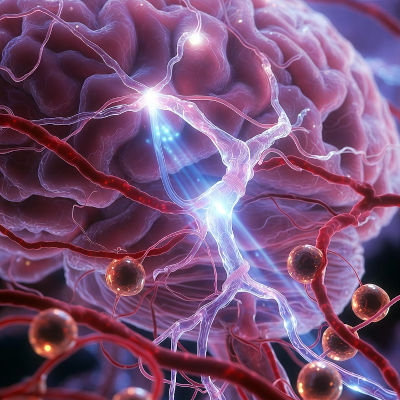

Researchers at Purdue University have created a new way to interface with the brain using materials that grow inside the body. The technique could help treat nervous system disorders such as epilepsy, Parkinson’s disease, chronic pain, and certain forms of depression by gently controlling brain activity without implants or surgery.
The key material is a conducting polymer called n-PBDF. Conducting polymers are soft, flexible materials that can carry electrical signals and interact safely with living tissue. This polymer forms when a small building block molecule is exposed to natural proteins in blood, especially hemoglobin. No harmful chemicals or added enzymes are needed. Once formed, the polymer responds to near-infrared light, which can pass through tissue with little damage.
In experiments, the polymer was grown directly inside brain tissue. It integrates well with surrounding cells and remains stable for months. When illuminated with very low-power near-infrared light, it can silence specific parts of neurons with millisecond precision. This allows researchers to turn neural activity up or down on demand without genetically modifying the cells.
A new paradigm for bio-integrated neural interfaces
The polymer works through a mechanism called thermionic modulation. This process directly affects ion channels on the cell membrane rather than changing the overall electrical properties of the whole cell. Ion channels are tiny protein gates that control the flow of sodium and potassium ions, which neurons use to send signals.
Unlike earlier approaches that required surgical implantation of stiff materials, this polymer grows softly in place using the body’s own chemistry. It avoids scarring and mechanical mismatch between hard devices and soft brain tissue. The material can also be turned on and off repeatedly, offering reversible control.
The breakthrough combines advances in polymer chemistry with neurotechnology. It opens possibilities for minimally invasive treatments and could eventually support wireless brain-computer interfaces, spinal cord modulation, and monitoring of heart or muscle activity with far less tissue damage.
Future work will focus on improving control over where the polymer grows, testing long-term safety in disease models, and developing wearable light-delivery systems. This research is published in Science.