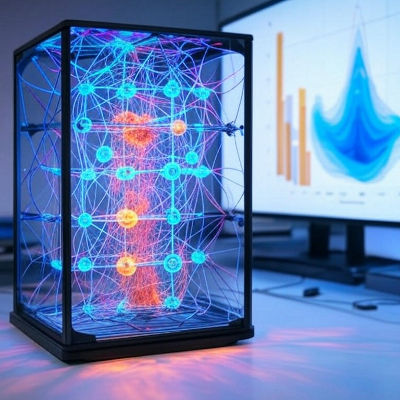

Boson sampling is a quantum computing method. For over ten years, scientists have studied boson sampling to show quantum computers can outperform classical computers. Past experiments proved boson sampling is hard for classical computers to copy, but it had no practical use.
Now, researchers from the Okinawa Institute of Science and Technology have found a way to use boson sampling for image recognition, which is identifying objects or patterns in pictures. This is important for fields like medicine, where it can help spot diseases in scans, or forensics, where it can analyze evidence.
In boson sampling, photons are sent through an optical network with mirrors and lenses, where they bounce and interfere in complex ways, creating patterns that are hard for regular computers to predict. The researchers used just three photons to keep the system simple and energy-efficient. They tested their method with grayscale images.
How the quantum system works
The researchers described the methods and results of this study in a paper published in Optica Quantum. They simplified image data using principal component analysis, a technique that shrinks data but keeps its main features. This simplified data was added to a complex quantum state of photons. The photons then passed through an optical network where they created unique patterns through interference. Detectors recorded where the photons landed, and repeating this process built a probability distribution, a map of likely outcomes. This map was combined with the original image data and sent to a linear classifier, a simple tool that learns to recognize patterns. Only this final classifier needed training, making the system easier to use than other quantum methods.
The results showed this approach was more accurate than similar-sized classical machine learning methods across different image sets, like handwritten letters or medical scans. The system worked without needing changes for each image type, unlike many traditional methods. While it cannot solve all problems, this method is a step toward practical quantum artificial intelligence (AI). The researchers plan to test it with more complex images to explore its full potential.