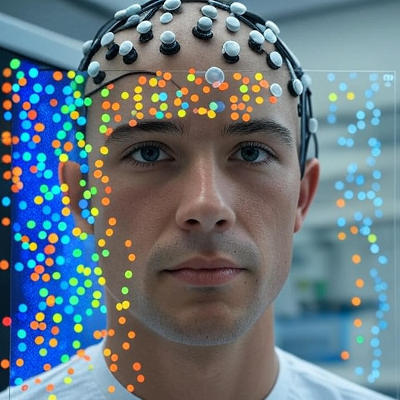

People often focus their attention before they even see something. This focus changes based on what they anticipate. Scientists have wondered if the brain starts with a wide trait, such as movement in general, or jumps right to a detail, like moving up or down. Researchers at UC Davis explored this by studying brain signals in people getting ready to spot colored dots moving on a screen. They used machine learning to analyze the results. The findings show the brain begins with a broad group and then refines to the exact trait.
The study is published in The Journal of Neuroscience. The researchers explained that the brain activates cells for the overall type first, then hones in quickly. This setup works like a ladder, where attention tightens over time to spot the expected item.
How the brain tunes in
To measure this the scientists used electroencephalogram (EEG) to brain electrical activity through sensors on the head. They also watched eye movements and applied machine learning. In the experiment, 25 adults aged 19 to 39 saw a blank screen, then got hints to watch for a blue or green dot, or one moving up or down. Dots appeared later, and the brain's prep time was timed.
The researchers note that focusing on color blocks out motion details at first, and the reverse happens too. Then, the brain ignores unneeded parts to highlight the key one. The software split the brain signals, showing general prep, like for color or motion, took about 240 milliseconds. Specific prep, like for blue or up, averaged 400 milliseconds.
The researchers compare this to flying toward a continent first, then aiming at a city. This insight into brain function might reveal issues in conditions like attention-deficit hyperactivity disorder or autism, where focus narrowing could lag. Better knowledge could lead to new ways to treat related problems.