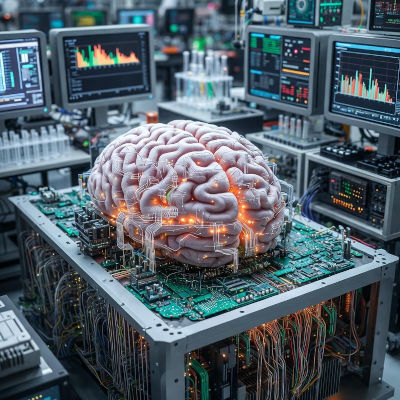

Neuromorphic computers are machines designed to work like the human brain. They are good at handling complex math tasks that help in science and engineering. Researchers at Sandia National Laboratories have created a new method that lets these computers solve partial differential equations, or PDEs. PDEs are math formulas used to model things like fluid flow, electric fields, and how materials bend under force.
This discovery means neuromorphic computers can do these calculations quickly and with little power. It could lead to the first brain-like supercomputer, which would change how we do energy-saving computing for important jobs like national security.
The brain does hard calculations all the time, like when a person swings a bat to hit a ball. These are big problems that the brain solves easily and cheaply. Traditional supercomputers use a lot of energy for the same work, but neuromorphic ones copy the brain's way to save power.
A new way to compute
The algorithm adapts a well-known model of brain networks, originally from computational neuroscience, to handle PDEs directly on neuromorphic hardware. This connection was unexpected because the model, introduced 12 years ago, had not been linked to PDEs before, revealing that brain-like circuits can naturally solve these equations with low energy, unlike traditional computers that require massive power for the same tasks.
This could help understand how the brain thinks and might give clues about brain diseases like Alzheimer's, which could be due to problems with how the brain computes.
For national security, this is key because simulating nuclear systems needs huge power. Neuromorphic computers could cut that down while keeping the results strong. The work also opens doors to mix math, brain science, and engineering for better tech.
In the future, this could handle even harder math methods. It solves real issues and helps answer big questions about computing.
The researchers have described the methods and results of this study in a paper published in Nature Machine Intelligence.
