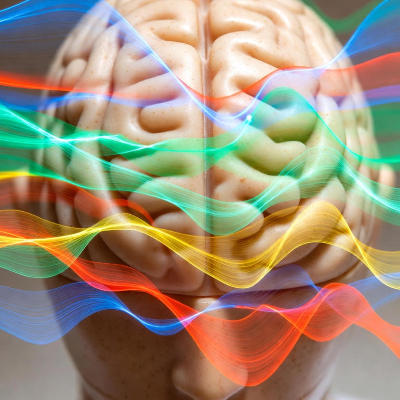

In a recent lecture at the Neuroscience 2025 conference Earl Miller, a professor at MIT, has suggested that thinking, or cognition, and awareness, or consciousness, arise from brain waves that organize the cortex through a process known as analog computing.
Analog computing handles information in a smooth, continuous way, unlike digital methods. Miller argues that the brain naturally uses these waves because they are efficient, fast, and reliable. The brain's millions of nerve cells, or neurons, constantly produce large-scale rhythmic electrical oscillations, across different speeds, or frequencies. Experiments from Miller's lab and others show these waves guide how information moves through the cortex and allow deliberate control of thoughts.
How waves organize the brain
A key part of this is top-down control, where the front of the brain, the prefrontal cortex, directs other areas to focus on goals. Miller's early work showed that neurons there are flexible, joining different groups as needed, rather than fixed like machine parts. Later studies revealed that slow waves carry goals and rules, while fast gamma waves handle sensory details. The slow waves limit the fast ones to shape thinking, such as holding items in short-term memory or making predictions. This setup lets people choose what to recall. Waves also travel across the cortex, either in lines or spirals, helping keep information active and timing mental steps.
In 2023, Miller introduced spatial computing, where slow waves act like templates to focus fast waves on specific brain patches, quickly forming networks without slow changes to connections between neurons. These waves unify the cortex, allowing a single awareness, as seen in theories like global neuronal workspace, which says consciousness needs linked brain regions. Waves enable this unity through their speed and by creating electric fields that group neurons reliably. For consciousness, large wave patterns bring the brain together for flexible planning. Studies with anesthesia, which causes unconsciousness, show it disrupts wave balance, travel, and timing, supporting the idea that waves are essential for awareness. Ongoing work aims to test this further.