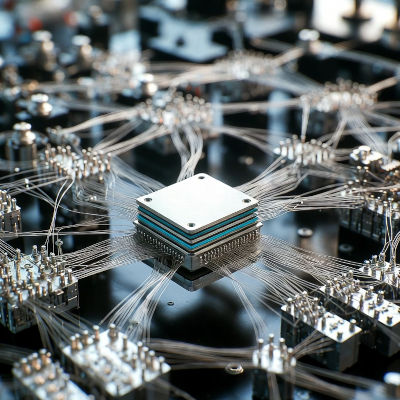

Researchers at the University of Cambridge have created a new nanoelectronic device that could greatly lower the energy used by artificial intelligence hardware. The device copies how the human brain works more efficiently.
Current AI systems use regular computer chips that move data constantly between separate memory and processing parts. This back-and-forth movement uses a lot of electricity, and demand keeps growing as more industries adopt AI.
Brain-like neuromorphic computing stores and processes information in the same place with very little power. This method could cut energy use and make systems more flexible. The key part is a memristor, a small electronic component that acts like the connections between neurons. It changes its resistance to store information and mimic learning.
Most memristors work by forming tiny conductive filaments inside metal oxide materials. These filaments form and break in unpredictable ways and need high voltages, which makes them hard to use in large systems.
The Cambridge researchers made a different kind of memristor using hafnium oxide, with added strontium and titanium. Instead of filaments, the device changes resistance smoothly by adjusting an energy barrier at this interface. This gives very uniform behavior from one switch to the next and from one device to another.
A promising step forward
The new memristors use switching currents about a million times lower than some older types. They show hundreds of stable conductance levels, which are needed for analog in-memory computing where calculations happen inside the memory itself. Tests showed the devices last through tens of thousands of switches and hold states for about a day. They also follow basic biological learning rules, such as spike-timing dependent plasticity, where connections strengthen or weaken based on signal timing.
One main challenge remains: the fabrication needs high temperatures around 700°C, which is too hot for standard chip-making processes. Researchers are working to lower this temperature for better industry compatibility.
This research is published in Science Advances.