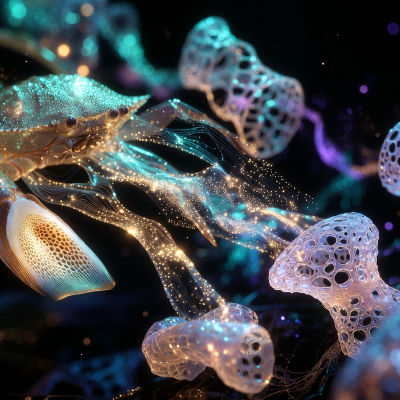

Researchers at MIT have created a new artificial intelligence tool named Bioinspired3D. It turns plain English descriptions of biological structures into ready-to-print three-dimensional designs. The system uses a compact language model with three billion parameters.
The model was specially trained on more than 4500 examples of biological shapes such as helices, cells, and tubes. Even though it is small compared to many current systems, it performs nearly four times better than its original version and beats several much larger models on a new test for creating bioinspired designs. To handle difficult requests, the system places the language model inside a larger setup called a graph-based agentic framework. This framework lets different artificial intelligence parts work together like helpers. It includes a vision-language critic. This critic looks at the generated three-dimensional shape and checks whether it matches the original description. It points out problems such as floating pieces or overlapping parts and helps fix them through repeated improvements.
From simple names to printed objects
The tool works together with another model called BioinspiredLLM, developed previously by the same researchers. Users can give it just the name of a natural material, such as horse hoof wall or crab exoskeleton.
The system then reasons about the material's internal structure and creates a matching three-dimensional design. In tests, it correctly produced a tube with changing levels of porosity for the horse hoof example, even though this type of graded structure was not directly shown during training. Several designs were turned into standard three-dimensional printing files known as STL files and successfully printed using common plastics.
The researchers say the work makes advanced generative design more accessible. They hope it will allow more research groups to take part in materials science without needing powerful computers. The full code, data, and model are available for anyone to use.
This research is published in AI for Science.