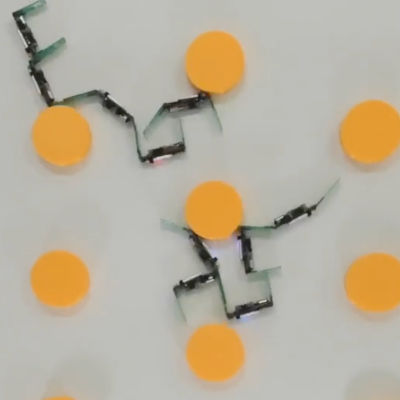

Cornell engineers have developed a robotic collective called the Cross-Link Collective. It consists of dozens of small robots that behave more like a flowing material than a conventional machine. The system can continuously reshape itself and adapt to its environment without centralized control, which means no single leader or main computer directs the group.
Each robotic module measures about 200 millimeters in length and 20 millimeters in width. A small motor inside each one makes it oscillate, or switch back and forth, between an “I” shape and a “U” shape. These movements push against the ground so the robot inches forward. Weak Velcro patches at both ends allow the modules to temporarily latch onto neighboring robots and then release. Alone, the modules move slowly and inefficiently. When they connect into chains, however, they begin to move together in coordinated ways and self-organize into shifting formations.
Simple physical rules enable resilient collective behavior
The system demonstrates what researchers call mechanical intelligence. This refers to useful behaviors that emerge naturally from the physical shape of the robots and their contacts with one another, rather than from explicit computer calculations or direct communication. On inclined surfaces, chains of connected modules advance more reliably than single robots, which often stall. In areas filled with obstacles, the collective flows around barriers like a liquid, forming temporary links to stay together and breaking them to prevent jamming.
The design is also highly resilient. If one module has a low battery or fails completely, the rest of the group continues to function because the system does not depend on any single unit. When a robot becomes isolated, it emits a simple audible buzz. Nearby modules respond by slowing down, giving the separated unit time to catch up and reconnect.
The approach draws inspiration from active gels, materials whose molecular links constantly form and dissolve while maintaining overall structure. Researchers view the Cross-Link Collective as a tool for studying how mechanical intelligence can produce adaptable and robust behaviors in robot groups. The work may guide future soft-matter engineering, the field of designing materials that change shape easily, for use in unpredictable real-world settings.
This research is published in Science Robotics.