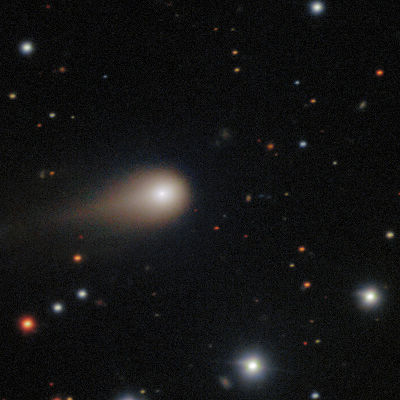

Researchers at Michigan State University have examined images of 3I/ATLAS, an interstellar object that passed through our solar system. The images come from NASA's Transiting Exoplanet Survey Satellite (TESS). The pictures show 3I/ATLAS as early as May, two months before its official discovery in early July. The findings are published in The Astrophysical Journal Letters.
The object got its name because it is the third interstellar visitor detected so far, marked as 3I, and ATLAS refers to the Asteroid Terrestrial-impact Last Alert System, a network of telescopes that first spotted it. Before discovery, 3I/ATLAS was too dim to notice among the stars. Now, with these new images, scientists see it had a comet-like tail. The tail suggests the object was active longer than expected, starting farther from the sun.
To get clear views, the researchers filtered out glare from nearby stars and stacked multiple TESS images taken over time.
Unexpected activity patterns
Such differences hint that comets and asteroids in other solar systems may have different makeup than those around our sun. The researchers said these rare visitors let scientists study far-off systems up close without traveling there. Comets usually release water vapor as they warm up close to the sun. But 3I/ATLAS showed signs of activity at greater distances, likely giving off carbon monoxide and carbon dioxide instead.
Michigan State University researchers published the first scientific paper just days after 3I/ATLAS was spotted.
Since its detection, astronomers worldwide have rushed to observe 3I/ATLAS and published papers almost daily before it fades from view in a few months. The object will soon pass beyond the reach of even the strongest telescopes.
The researchers plan more studies using NASA's james webb space telescope (JWST). This will reveal more about 3i/atlas's composition. Federal funding supports these missions, aiding discoveries that place humanity in the universe's broader context and edge closer to questions like whether life exists elsewhere.