What if the ancient Taoist concept of effortless action could be expressed through mathematics to guide the behavior of advanced Artificial General Intelligence (AGI)?
In Taoist philosophy, "wú wéi" does not imply passivity or doing nothing. Instead, it refers to acting without forcing—responding so perfectly to a situation that effort seems to vanish. This type of action feels natural and aligned with the flow of events. In a recent research paper, Dr. Ben Goertzel proposes that wú wéi can be understood as a precise mathematical principle relevant to future AGI systems.
The researchers suggest that effortless action is essentially action that introduces no unnecessary structure or representational complexity. This article explores how bridging ancient philosophy with abstract mathematics could help create intelligent systems that choose their paths with grace rather than force.
The Structure of Effortlessness
To formalize spontaneity, the research utilizes an advanced mathematical object known as a "quantale." This structure allows researchers to reason about cost and composition in a general way. In this framework, "weakness" is used as a measure of cost.
Rather than measuring effort in energy or time, the researchers define weakness as the amount of extra structure required to carry out a transition from one state to another. Within this system, moving from one state to another has a cost based on added complexity, while staying in the same state has zero cost.
Geodesics and Spontaneity
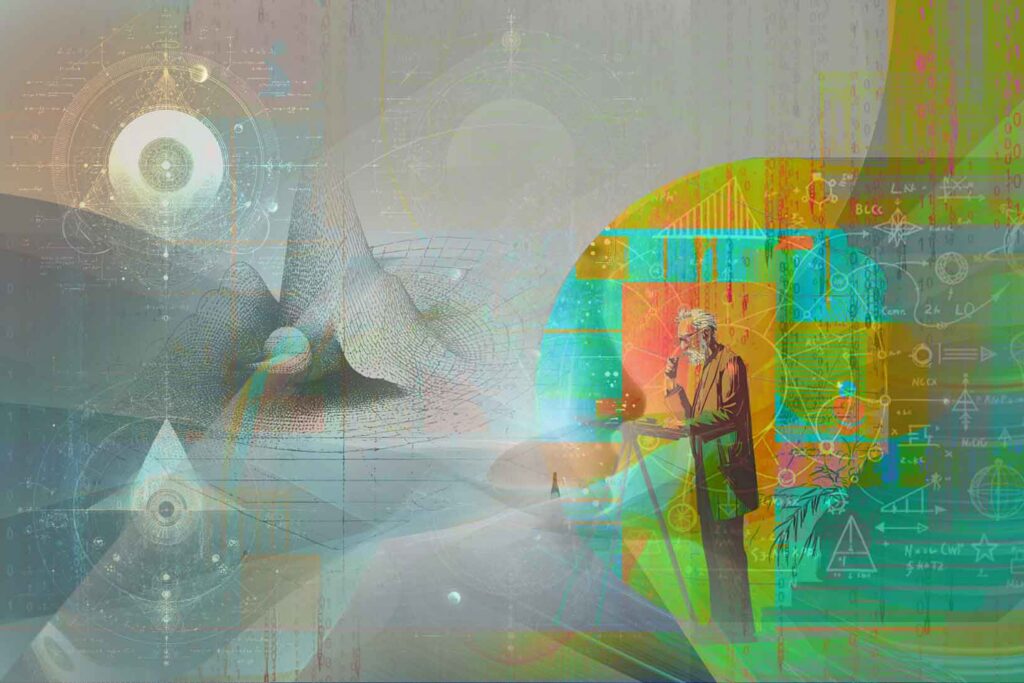
Once effort is mathematically defined, a concept called "geodesics" emerges. In geometry, a geodesic is the shortest path between two points. In a space measured by representational effort, a wú wéi geodesic is the path that adds the least unnecessary structure.
Acting with wú wéi means moving along these minimal-weakness paths. Each step does exactly what is required to reach a goal—no more, no less. This suggests that spontaneity is not randomness, but rather a perfect alignment with the underlying structure of a situation.
Redefining Motivation in AGI
The researchers also connect these ideas to "MetaMo," a framework for modeling motivation in intelligent agents. In this model, motivation is not a static list of preferences but a flow of effort across a space of goals and constraints.
An agent practicing wú wéi selects actions that are "Kan-optimal extensions," meaning they are the least costly way to extend the agent's current state. This approach allows an AI to move "with the grain" of reality. For example, an AGI mediating a conflict would intervene only where the situation invites it, avoiding forced resolutions.
Conclusion
This research presents a general overview of how ancient philosophy can inform modern AI safety and design. By defining the problem of "forcing" in AI transitions, the researchers highlight the significance of creating systems that operate with minimal representational effort.
The study suggests that future AGI development should focus on these minimal-cost paths to ensure actions are appropriate rather than just optimized. Implementing wú wéi as a mathematical strategy offers an actionable recommendation for building more harmonious technology. As we look toward the future, the goal is to develop intelligence that aligns with its context, ensuring that high-tech systems can finally achieve a state of "flow."
Reference
Goertzel, Ben. "A Mathematical Formalization of Wú Wéi using Quantales and MetaMo." arXiv.org, 2024. [URL]