

Abstract:
Human activity beyond Earth is shifting from episodic scientific missions toward sustained commercial and operational activity, especially the Moon and Mars. Current space governance frameworks were aimed, in the first place, at averting biological pollution and geopolitical confrontation, and the large-scale modification of extraterrestrial landscapes remained largely unregulated. The paper posits that the idea of environmental impact assessment must not be limited to Earth even without the presence of ecosystems, as a means of safeguarding the scientific worth, exhaustible resources, cumulative environmental impacts, and intergenerational equity. Basing its arguments on the new literature, the paper uses terrestrial experiences including the Antarctic system of governance and deep seabed mining, and proposed models of sustainability, to shape up a paradigm of the Extraterrestrial Environmental Impact Assessments (EEIAs). It suggests that the main regulatory tools can be baseline geological mapping, predictive modelling, protected areas, long-term accounting of resource depletion, and financial guarantees. The article reaches the conclusion that to avoid the irreversible degradation, the implementation of environmental assessment mechanisms should be adopted very early and that stewardship principles should be inscribed in the first century of off-world industrial activity of humanity.
Introduction:
The growth of space activity is a radical change in the symbolic exploration to industrial operations. Missions that were confined to the services of flag planting and data collection have now included the schemes of extracting water ice, building upon permanent habitats, and processing materials fuel and manufacture. The operation of lunar mining, prospecting of near-Earth asteroids, and the development of infrastructures around the Moon and Mars are being developed by governments and private organizations.
However, even the legal frameworks of these activities are still based on the Cold War priorities: preventing biological pollution and the possibility of a geopolitical conflict. They have no significant control over the irreversible change of extraterrestrial landscape or safeguard common scientific worth.
On Earth, environmental impact assessment (EIA) is a key regulatory mechanism that helps to assess the probable effects that large scale projects have on the ecosystem, human communities and long term sustainability. However, the conventional role of EIAs presupposes the presence of ecosystems and human-environment interactions - which are not possible or completely dissimilar on such celestial objects as Moon or Mars.
This paper presents the view that regardless of the absence of ecosystems in the areas, environmental impact assessment should go beyond the Earth to safeguard the scientific value, exhaustible resources, cumulative
effects, and entitlement of future generations. It is not abstract idealism; such an approach is already prepared by a number of scholars proving that it is conceptually sound and highly necessary.
The last geopolitical and commercial events make the necessity of environmental management on our planet outside more urgent. There are open plans of sustained lunar and Martian missions by national space agencies and commercial companies that would include surface infrastructure, use of in-situ resources and permanent installations. Organisational-led programs like the ones offered by National Aeronautics and Space Administration, the Indian Space Research Organisation, and the China National Space Administration are more than ever mixed with ambitious commercial programs being pursued by organisations like SpaceX. Such is a congested strategic environment that the possibility of overlapping claims to scarce high-value areas exists, especially lunar polar areas with abundant water ice. In the absence of widely recognized standards of environmental licensing, interstate competition in regulation may stimulate lax policies to prevent investment flight, in the imitation of terrestrial race-to-the-bottom behavior. These geopolitical realities render the absence of extraterrestrial environmental assessment mechanisms no longer speculative but an imminent governance challenge.
The Space Governance Legal Vacuum.
The existing space law is based largely on a few multilateral treaties and guidelines formulated in the early years of space operation. Among them:
The Outer Space Treaty focuses on peaceful use and bans any claim of sovereignty, but it is not saying much about environmental regulation.
Planetary protection standards are concerned with ensuring that the Earth life is not transferred to other planets and the foreign organisms to Earth during return missions.
The commercial space launch licensing regimes at the national level usually focus on safety, collision, and mitigation of debris, and do not allow extensive environmental examination.
According to S.E. Mustow the current regime does not include centralized screening or evaluation of environmental impact of extraterrestrial projects, i.e. the mining operation or the construction of large-scale infrastructure development can continue without regulation of its effects on terrain or resource exhaustion (Mustow, 2018).
To put it briefly, space governance manages extra-terrestrial spaces as though absence of biological life is environmental irrelevance, and in this manner the regulatory vacuum has been created just as humanity is about to industrialize other planets.
Redefining an Environment Without Life.
In order to make environmental impact assessment relevant outside the Earth, one must extend the definition of the term environment on law and ethics.
The history of environmental law on Earth started by ensuring the protection of living systems and human welfare. However, the concept may be expanded to include:
1. Scientific worth, unusual geological structures, ice beds, and topography contain inimitable information concerning planetary history.
2. Finite resources - water ice and volatile compounds are non-renewable resources that have strategic significance on future missions.
3. Long-term effects - recurring missions may cause dust clouds, disequilibrium of thermal, and deterioration of scientific settings.
4. Intergenerational equity - future researchers and explorers must not have to deal with a landscape that is either depleted or changed forever.
These are notions that are in line with the new science of space environmental sustainability. W. Mo et al. suggest considering landscape change and resource depletion as aspects of environmental impact, pollution, and justice, and offer a wider range of how to measure harm even in the lack of ecosystems (Mo, et al., 2024). This re-conceptualization is necessary not because people have sentimental attachments to rocks or craters, but to appreciate that the irreversible change has value implications that the existing law is not able to achieve.
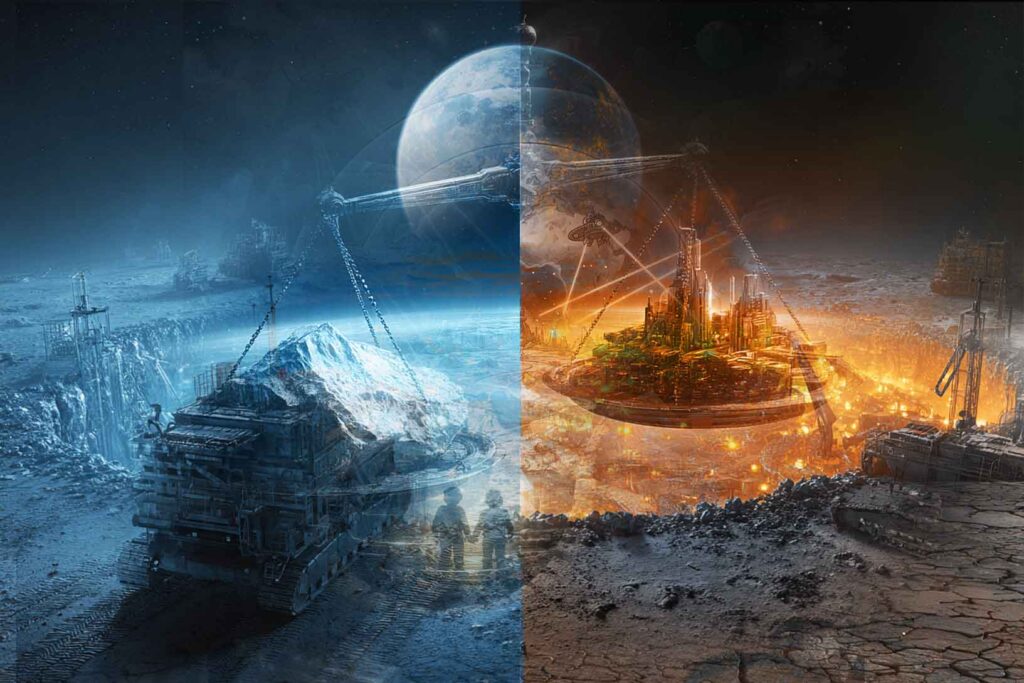
Comparative Analogies: When There are No Human Populations on Earth.
Even non-permanent environments are already controlled by legal systems:
Antarctic Governance
The Antarctic treaty and the environmental protocols consider Antarctica as a natural reserve, dedicated to peace and science. Mineral mining is also forbidden and planned activities must be thoroughly vetted by the environment (Antarctic Treaty System). The justification is not ecological complexity or permanent human presence, but the preservation of pristine terrain and scientific opportunity.
Deep Seabed Mining
Deep-ocean mining is controlled by the International Seabed Authority (ISA) which needs to carry out baseline research and environmental monitoring even though there is little biological information available. Its guideline has secured regions and impact appraisal, which understand that poorly comprehended systems merit precautionary consideration (ISA, 2023).
These illustrations reveal that environmental governance is not pegged upon flourishing ecosystems but values attributed to the integrity of the landscape, scientific opportunities, and common heritage which find applicability in space.
Extraterrestrial Environmental Impact Assessment (EEIAs): A Proposed Framework. Based on the principles on Earth and the new scholarly literature, a feasible EEIAs paradigm would entail:
Baseline Mapping
Prior to any large-scale excavation or building, operators would have to record use conditions such as geological, resource distribution, thermal gradient, and dust dynamics. This is necessary so as to differentiate the conditions of natural baseline and those that can be ascribed to human activity.
Predictive Modelling
Activities need to be examined in terms of a long-term impact, including:
1. mobilization and redistribution of dust,
2. thermal regime changes,
3. change of reflectivity on the surface,
4. Depletion of finite reserves.
According to Dallas et al., such modelling should be made to meet the special physics of low-gravity environments and it needs to inform liability and mitigatory planning (Dallas, et al., 2021).
Zoned Areas of Protection and Control.
Protected zones should be declared in certain areas, which have a great scientific interest like permanently shadowed craters. This effect resembles the concept of planetary parks, proposed by Cockell (2024), that proposes the protection of places of unusual scientific and historic significance. These areas would need increased thresholds in their evaluation or complete limitations based on the proposed activity.
Intergenerational Accountability
The impact assessment should not only focus on the immediate impacts but also how resource mining or the way the landscape is changed must restrict the opportunities of future generations. This involves long planning horizons and representation of the stakeholders that involves scientific coalitions as well as non-spacefaring states.
Financial Guarantees
Similarly to most terrestrial EIAs, space activities might be conditional upon environmental bonds or mitigation funds, space activities might be conditional upon financial bonds covering monitoring, remediation or compensation of cross-mission effects.
Case Studies of the EEIAs Importance:
1. The first example is the extraction of ice at Lunar Polar Regions.
Water ice could be present in permanent shadowed craters at the lunar poles, which, once more, can be essential in exploration and in-situ production of propellant required in the future. However, mining activities might spread the fine grains of ice to the adjacent landscape, distort scientific indicators, and modify the local albedo (reflectivity), which influences temperature distributions.
An EEIAs would involve extensive mapping of ice beds, simulation of effects of dust and heat as well as factoring in long-term depletion rates. In its absence, irreversible change is likely to take place before anyone has the information to comprehend its complete impact.
2. The problem under consideration is the Regolith Excavation of Mars Landing Sites. The previous rover missions have already yielded useful scientific information on Mars. A massive excavation around historic landing locations may eradicate geological surroundings containing the indications of ancient climatic conditions and conceivable biosignatures. The protection of such areas is suggested by structures such as planetary parks (Cockell, 2024).
EEIAs might regularize the weighting between scientific heritage and commercial or logistical interest - moving such decisions to the forefront and out of intuition.
Addressing Objections:
Objection: Space is not animate and as such, it does not cause environmental damage. Response: Ecosystems are not necessary in response. Change of rare geological account and exhaustion of non-renewable resources is an environmental change worth evaluation as is the landscape concurrence through Antarctic governance as valuable regardless of small ecosystems.
Objection: Regulation will discourage innovations.
Response: Foreseeable legal systems will lower uncertainty and give an incentive to invest. The terrestrial industry frequently leans towards the unambiguity of rules rather than the ambiguity of the law.
Objection: Treaties forbid appropriation, and EEIAs are dangerous in the establishment of de facto property regimes.
Response: EEIAs are not ownership conferring. They control the terms of use - just like the terrestrial EIAs control construction and development but do not transfer title to land.
Jurisdiction and Enforcement Problems:
Application of EEIAs would necessitate adjustment of the prevailing systems of governance: 1. The Outer Space Treaty still holds states liable to actions of their nationals.
2. Approval could be on the basis of good compliance with EEIAs by the licensing authorities. 3. The transparency means between states may entail publicity of presented assessments.
4. The insurance market can also contribute to this by imposing environmental risk in the form of prices in the coverage requirement.
This would require enforcement to be a combination of national regulation ability, international peer pressure, and economic incentives, just as on Earth.
The actual implementation of Extraterrestrial Environmental Impact Assessment would probably be done by national licensing bodies, who also have regulatory authority over launches and mission licensing. As an illustration, in the United States the Federal Aviation Administration, via its Office of Commercial Space Transportation, licenses the private launches, and can put conditions on safety and operation as part of the approval process. Such licensing regimes could include environmental compliance requirements and an inability to meet the EEIAs obligations could lead to mission authorization rejection, suspension, or amendment. Other national regulatory systems that control the operation of the private space operators have a similar leverage. To avoid regulatory arbitrage, international coordination would still be necessary, especially in the case of multinational missions where the component may have been launched in multiple jurisdictions. The transparency measures, which may compel the states to release adopted EEIAs, along with the efforts of the insurance market and diplomatic controls, would slowly have been able to create internationally aligned environmental standards even in the absence of a centralized extraterrestrial regulator.
Conclusion: Before Scarcity Stewardship
The human race is on the verge of an important breakthrough in its association with outer space. What started as a periodical scientific investigation is gradually becoming a permanent presence, commercial mining and infrastructure building on the surfaces of celestial bodies like the Moon and Mars. This shift challenges international law to address a question it has been long evading and that is whether the world without ecosystems is legally and morally absolved of environmental regulation.
This paper has claimed that they are not. The destruction of forests, seas or native life does not render environmental value to be non-existent. Geological phenomena archive the history of the planets that cannot be recreated once it is disrupted. Water ice and other volatile deposits are not limitless, and determine the viability of future missions and settlement. The redistribution of dust, thermal changes, and excavation at a large scale could change the features of the surface, permanently restricting the scientific investigation over centuries. These interests are very well-equipped with the original purposes of environmental law on Earth, avoiding irreversible damage, distributing common resources, and safeguarding the claims of the future generations.
The current systems of space governance, which are based on planetary protection and state responsibility, were made to fit in a time of limited activity. They are ill-formed to control industrial activities that can rebuild extraterrestrial landscapes on a large scale. As the experience of governing the Antarctic and of regulating deep-sea mining and the location of nuclear-waste has shown, law has already been applying itself to remoteness or to thinly populated sectors in situations where the long term and irreversible effects are at stake. The fact that environmental impact assessment has been extended into outer space is thus not a radical innovation as far as legal tradition is concerned but a logical extension of precautionary governance.
Extraterrestrial Environmental Impact Assessments provide a viable way ahead. EEIAs would not outlaw development but would impose discipline on it by, among other things, demanding baseline studies, predictive modelling, definition of safe areas, long term accounting of resource wastage, and financial securing mitigation. They would bring transparency in decision-making processes which are currently made by disjointed national licensing procedures, minimise the chances of confrontation between the operators and give reason to collaborative international oversight. Most importantly, they would introduce foresight in the very first industrial traces that humanity has left on the planet, instead of trying to regulate it after the fact when it is already too late.
Finally, there is no need to debate whether mankind should expand past the planet. The latter is already taking that course. What will come with that expansion is the question of what legal and ethical posture will be. When outer space is viewed as a field in which regulation is only enforced once the degradation is very evident, then early decisions can fixate patterns of exploitation that will be irreversible to the future generations. Conversely, implementing environmental assessment mechanisms at the start is an indication of stewardship and not opportunism in the short run.
The first century of sustained off-world presence will shape the extraterrestrial surroundings over a millennium. The current decisions regarding mining, building and preservation will either leave behind the scars and depleted resources to the future generation of explorers or leave behind well-managed territories that can still hold their scientific and strategic potential. Assessment of the environmental impact taking place outside the Earth is thus not just a regulatory fine-tuning. It is a statement describing how humankind perceives its duties when it stops being tied to one planet.
Reference:
1. Dallas. J., et al. (2021). An Environmental Impact Assessment Framework For Space Resource Extraction. https://www.sciencedirect.com/science/article/abs/pii/S0265964621000333
2. Charles. S Cockell. (2024). Planetary park twenty years on: balancing space protection with development. Space policy.
https://www.sciencedirect.com/science/article/pii/S0265964624000389 3. Mo,W., et al. (2024). Conceptualizing space environment sustainability.