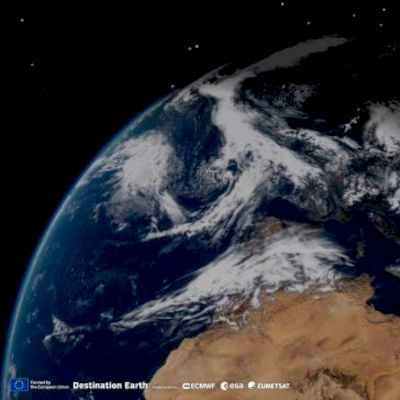

The European Commission has confirmed the third phase of Destination Earth, known as DestinE. This initiative creates a highly accurate digital replica of the Earth system, which is a virtual model of the planet's climate, weather, and natural processes. It allows users to explore past, present, and future conditions, including simulations of "what-if" scenarios to understand risks from climate change and extreme events like floods or heatwaves. This helps governments and organizations prepare and adapt to these threats. The project is carried out by the European Centre for Medium-Range Weather Forecasts (ECMWF), the European Space Agency, and the European weather satellite organization.
In the first two phases, experts built key parts of the system. These include the Climate Change Adaptation Digital Twin, a virtual tool for long-term climate projections at high detail, and the Weather-Induced Extremes Digital Twin, which simulates severe weather and its effects globally or in specific areas. They also developed the Digital Twin Engine, software that runs these models on powerful supercomputers. A major focus was on artificial intelligence (AI). This led to AI models for parts of the Earth system, such as land, ocean, and ice, paving the way for a full AI-based Earth model that works alongside traditional physics simulations.
Advancing AI for environmental intelligence
In phase three, set to run from June 2026 to June 2028, the partners will operate and improve these digital twins and the engine. Special emphasis is on evolving AI capabilities, like turning digital twin data into high-quality sets ready for Europe's AI Factories, which are centers for developing and using AI tools. This includes building an AI Earth-system model that combines physical science with AI to boost accuracy, handle uncertainties, and enable quick experiments. AI solutions, such as a "forecast-in-a-box" for easy predictions and a digital twin assistant for interactive data use, will make the system more user-friendly. These AI applications aim to enhance Europe's weather and climate forecasting, support public services in protecting communities, and drive innovation in industry by providing reliable environmental data.