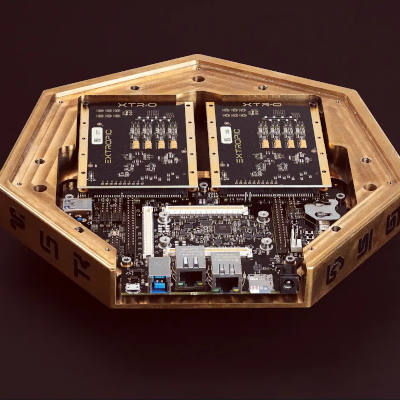

Artificial intelligence (AI) scaling needs either more energy production or better efficiency in hardware and algorithms. AI company Extropic has developed new energy-efficient hardware and algorithms for generative AI. This includes a scalable probabilistic computer, a machine that works with probabilities rather than fixed numbers to handle uncertainty in data. They built circuits that use much less energy for sampling tasks, which involve picking values from probability distributions, and a new AI algorithm that cuts energy use dramatically compared to standard methods on graphics processing units (GPUs).
To share their work, Extropic released a hardware prototype called the XTR-0, already tested by partners, and an academic paper on their thermodynamic sampling unit (TSU), a hardware component that samples from complex probability distributions using energy-based models. These models define probabilities through an energy function, where lower energy states are more likely. They also launched a python library for simulating this hardware to develop new ai algorithms.
Scaling beyond energy barriers
Extropic sees AI as key to progress, but current AI technology would demand too much energy for widespread use. Their approach focuses on efficiency rather than just more power. Traditional chips waste energy on data movement, but Extropic's design uses local communication and noise in circuits for randomness, making it more efficient. The TSU performs sampling directly, skipping heavy calculations like matrix multiplications used in standard AI.
Their denoising thermodynamic model, inspired by diffusion models that gradually refine noisy data into clear outputs, runs on this hardware with up to 10,000 times less energy on benchmarks. Simulations show promise, and an open-source replication confirms the results. This could remove energy as a barrier to AI expansion.
Looking ahead, Extropic plans to scale up for larger AI tasks and seeks experts in circuits, probabilistic machine learning, which is AI dealing with uncertainties, and partnerships for biology or chemistry simulations.
Wired (open copy) notes that Extropic CEO Guillaume Verdon gained notoriety as the founder of "a new techno philosophy known as effective accelerationism or e/acc" before founding the startup.