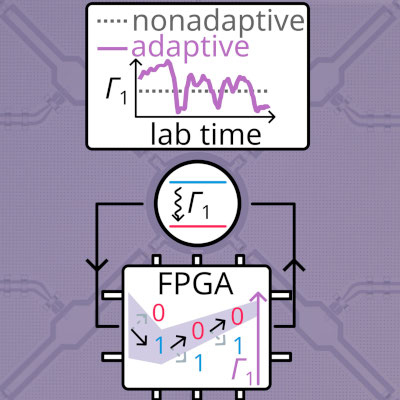

Qubits, the basic building blocks of quantum computers, hold quantum information and are very sensitive to their surroundings. Materials around qubits often have tiny defects that cause fast changes, or fluctuations, in how quickly a qubit loses energy and information. These fluctuations can happen hundreds of times per second, making qubits unreliable.
In the past, measurements took up to a minute, so researchers could only get an average energy-loss rate, missing the quick changes. This gave an incomplete view of qubit performance, like trying to farm with unseen obstacles constantly shifting in the field.
Now, researchers at the Niels Bohr Institute have developed a real-time way to track these fluctuations using a fast controller. This approach updates the estimate of a qubit's energy-loss rate in milliseconds, matching the speed of the changes themselves.
The method uses a field-programmable gate array, or FPGA, which is a quick classical processor that can be programmed for specific tasks. It runs experiments directly, making guesses about energy loss from just a few measurements without slow computer delays. The FPGA updates its knowledge after each qubit measurement, adapting efficiently.
Achieving real-time monitoring
This setup allows the controller to evolve at the same pace as the qubit's environment, detecting fluctuations about 100 times faster than before. Researchers found that fluctuations in superconducting qubits happen much quicker than expected.
The FPGA controller comes from commercially available hardware, programmable in a language familiar to physicists, making it accessible worldwide. It integrates logic, measurements, and adjustments tightly, enabling the experiment.
This work shows that qubit performance is limited by the worst qubits, which can turn bad in fractions of a second. The new algorithm spots good and bad qubits in real time and gathers data on issues quickly.
While some fluctuations remain unexplained, understanding them is key to building larger quantum processors. This progress highlights how combining advanced quantum hardware with fast control can push quantum technology forward, moving toward practical calibration and monitoring.
This research is published in Physical Review X.