
Finger-worn device can 'translate' text messages to braille on-the-fly

Finger-worn device can 'translate' text messages to braille on-the-fly

A demo of a novel 3D-printed bio material for "augmented humanity"
AA
Amara Angelica
Sep 22, 2023
2 min read

Engineers and chemists at Lawrence Livermore National Laboratory (LLNL) and Meta have developed a new kind of 3D-printed material that can replicate some characteristics of biological tissue.

The researchers say the advancement could impact the future of “augmented humanity,” where technology enhances human performance by closely interfacing engineered devices with our anatomy. 

Emulating the range of bio materials

As described In a paper in the journal Matter, the method patterns smooth gradients in stiffness to approximate gradients found in biology, such as where bone meets muscle. This overcomes “mechanical mismatch” (natural tissues are soft; electronic devices are usually made of rigid materials).

“For engineers, it’s very hard to get a softer material combined with a stiffer material such as is common in nature,” explained lead author and LLNL engineer Sijia Huang. “Engineers make a part that is stiff and another part that is soft, and then manually assemble them together, so we have a very sharp interface that compromises the mechanical property.

The new technique works by manipulating the intensity of light applied to a photopolymer resin, using a layer-by-layer technique that can rapidly produce parts by projecting light into a liquid resin. Lower light intensity results in a softer material; higher light a stiffer material.

Wearable braille display

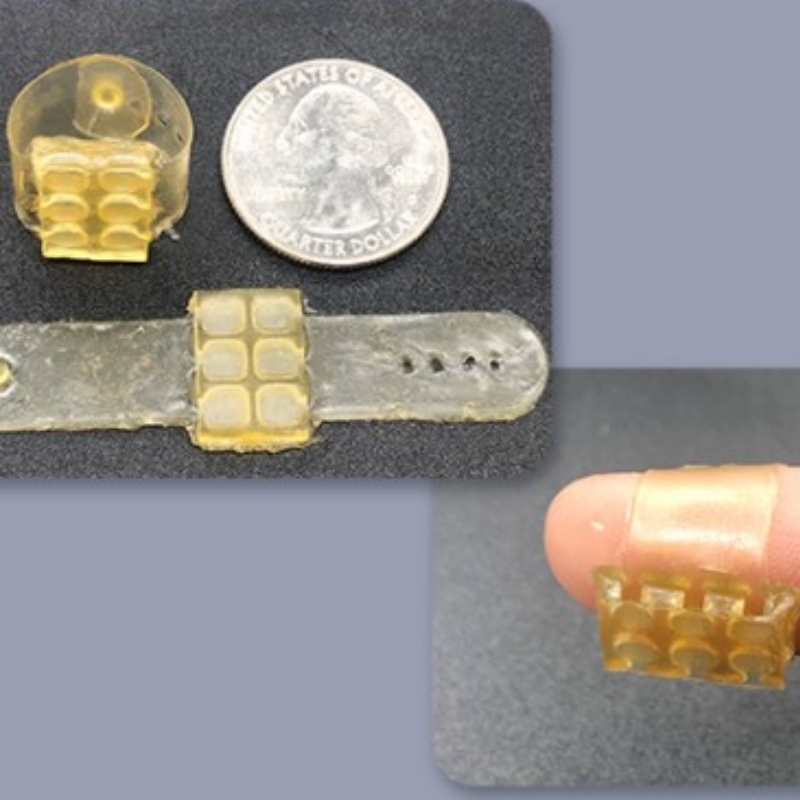
To demonstrate the potential, engineers at Meta used the material to 3D-print an inexpensive braille display that could be worn on a single finger and connected to a smartphone and an air pump.

When text is transmitted via the phone, sections of the wearable fill with air, causing it to deform and create braille letters, enabling a sightless person to “read” the text through the device.

The material is stretchable to around 200 times its original properties, and as its gradient transitions from soft to stiffer material, its toughness increases by 10 times. Huang said the material could be tailored for energy-absorbing materials, soft robotics and wearable electronic devices.

Citation: Sijia Huang et al. (June 20, 2023) One-pot ternary sequential reactions for photopatterned gradient multimaterials. Matter. DOI: https://doi.org/10.1016/j.matt.2023.05.040 (open-access)

About the Writer

More from Mindplex

Keep reading

Three more ideas worth your time.

Browse News

Discussion

Join the discussion

Sign in to share a response with the community.

Type @ to mention someone Type / or use + to add a block Highlight text, then choose Link
Loading editor

Comments cannot be edited after posting because they become part of the reputation record. Give yours a quick review first.

<p>Hi, Henderson. Thanks for that interesting comment! Re "potential ethical dilemmas": any ideas on how to do that without limiting research? I'd like to explore that... — Amara</p>
<p>This development is absolutely mind-blowing! The fusion of cutting-edge technology and the emulation of biological tissue is a remarkable stride. It's like something out of a sci-fi movie.</p><p>What's particularly impressive is how they've managed to mimic the gradients found in nature, like where bone meets muscle. I recon, the struggle to combine materials with differing levels of stiffness has always plagued engineers.</p><p>But here we are, on the brink of a technological revolution that could profoundly impact our lives yet no alarm on the ethical side?</p><p>While we're all marveling at the technological wizardry, let's not forget the ethical elephant in the room. After all Meta is part of it, Facebook eh?</p><p>The potential to enhance human performance is exciting, augmented humanity! This raises some prickly moral questions. Are we stepping into territory where the line between man and machine blurs a little too much? Is it for the rich and powerful? And what about privacy concerns when we're strapping wearable devices to our bodies that can interface with our anatomy? It's a bit Black Mirror, if you ask me.</p><p>Don't get me wrong; I'm all for progress and innovation, but we must ensure it's done with ethics and transparency in mind. We don't want to end up in a world where technology rules every aspect of our lives without our consent or understanding. In addition, access to this kind of technology is pretty much locked for the jet set!</p><p>So, while this advancement is undoubtedly impressive, let's also keep an eye on the bigger picture and the potential ethical dilemmas it might bring along for the ride.</p>