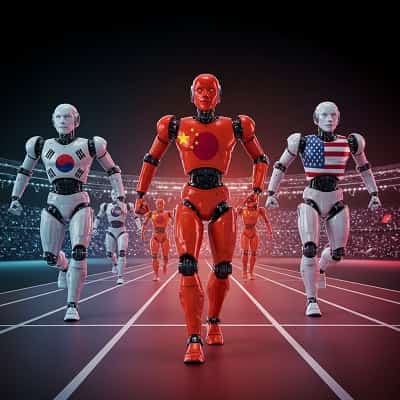

A couple of weeks ago, the world witnessed a robot's grit in athletics: Tiangong Ultra, a humanoid robot, crossed the finish line first in the world’s inaugural E-Town Humanoid Robot Half-Marathon in Beijing, completing the 21-kilometer course in 2 hours and 40 minutes. This milestone underscores the global surge in humanoid robot development, with companies like Hyundai, Tesla, and Samsung racing to transform industrial workspaces.
Hyundai Mobis, the parts arm of Hyundai Motor Group, announced plans to develop actuators—key components comprising 40% of robot hardware costs—for humanoid robots. Its affiliate, Boston Dynamics, aims to deploy its Atlas robot commercially by 2028. At Hyundai’s Asan plant, where 90% of pressing and 80% of welding tasks are automated, humanoids could tackle the 15%-automated interior assembly process, per senior researcher Lee Seo-hyun of the Korea Automotive Technology Institute.
Tesla targets producing 5,000 Optimus robots in 2025 for factory use, potentially marking the first large-scale industrial deployment. BMW is training Figure AI’s robots at its Spartanburg, South Carolina plant, while Mercedes-Benz has deployed Apptronik’s Apollo robots in Germany and Hungary since March 2024, focusing on repetitive tasks.
Electronics giants are also diving in. LG Innotek partnered with Boston Dynamics on April 14, 2025, to develop vision sensors, while Samsung Electronics, after acquiring Rainbow Robotics in March, is accelerating humanoid projects. The global humanoid market, valued at $3.28 billion in 2024, is projected to hit $66 billion by 2032, per Fortune Business Insights.
Despite Korea’s efforts, experts like Hwang Myeon-jung of the University of Seoul note it trails the U.S. and China, where real-world testing drives progress. China’s 451,700 robotics firms, up 206.7% since 2020, benefit from initiatives like “Made in China 2025.” Korean stakeholders must prioritize field deployments to compete, Hwang urges.