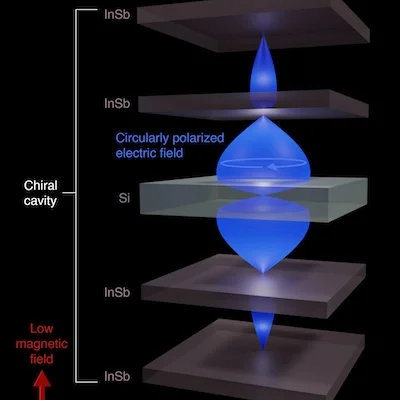

Vacuum is not empty but filled with virtual photons that appear and disappear quickly. They can interact with materials, changing their properties in useful ways. Scientists use optical cavities, mirror structures that trap light, to control these energy bursts. This helps create new types of materials with special features.
Researchers at Rice University have created a new type of optical cavity that boosts the quantum vacuum fluctuations of circularly polarized light in a single direction. This is called chirality. Normally, achieving chirality in cavities needs a strong magnetic field, which can cause unwanted changes in materials. The new cavity design uses a material called indium antimonide, a semiconductor used in devices like infrared detectors, to achieve chirality with a much weaker magnetic field.
A new approach to material transformation
This new cavity changes how materials behave when placed inside it. For example, the researchers studied graphene, a thin, strong layer of carbon atoms arranged in a hexagonal pattern. When graphene is placed in the cavity, it turns into a special insulator, a material that does not conduct electricity. This insulator has unique properties useful for quantum computing. The cavity achieves this by enhancing the vacuum’s energy bursts in one direction while suppressing them in the other, all with a low magnetic field.
The researchers used computer simulations to design the cavity efficiently, avoiding the need to build many physical models. They also combined classical and quantum physics to predict how materials would change. This approach made their predictions more accurate. The cavity’s design is versatile and can be used with other materials, opening the door to creating new quantum materials for advanced technologies. This work shows how reshaping the vacuum’s energy can lead to innovative ways to engineer materials without relying on extreme conditions like high magnetic fields.
This research is published in Nature Communications.