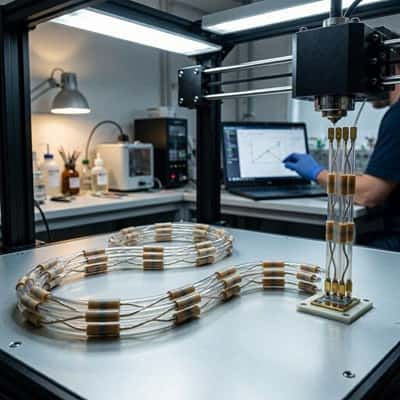

Harvard engineers have created a new 3D printing method that turns soft, hair‑like filaments into programmable “artificial muscles” that bend, twist, expand, or contract when heated or cooled. The technique, called rotational multimaterial 3D printing, was developed in Jennifer Lewis’s lab at the Harvard John A. Paulson School of Engineering and Applied Sciences.
The method prints two materials side‑by‑side through a rotating nozzle: an active liquid crystal elastomer (LCE) that shrinks when heated and a passive elastomer that remains unchanged. By controlling the rotation, the researchers “write” a helical alignment of the LCE, directly pre‑programming the filament’s curvature and twist without assembly or post‑processing.
The team demonstrated soft‑robotic functions including temperature‑controlled filters that open or close to trap objects and pick‑and‑place grippers that can lift multiple rods at once. Using custom nozzles, they have printed filaments as small as roughly 100 microns in diameter. The work appears in Proceedings of the National Academy of Sciences (PNAS, 22 April 2026) and points toward applications in reconfigurable grippers, active medical filters, and injectable biomedical structures.