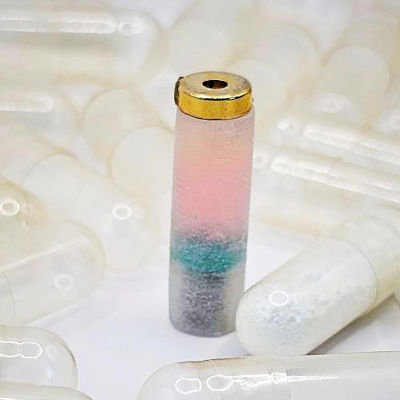

Soft tissue injuries in the gastrointestinal tract, such as ulcers or bleeding, often need surgery. Surgery is invasive, and may not fix the problem permanently. Bioprinting is a new method that uses a special "ink" made from natural materials like seaweed to print tissue scaffolds - structures that help new cells grow - directly on the damage site. However, current bioprinters are large and require anesthesia. Meanwhile, "untethered" devices, like smart capsules guided by magnets, deliver drugs inside the body but struggle to move properly when touching tissue walls.
Researchers from the Laboratory for Advanced Fabrication Technologies at EPFL’s School of Engineering created MEDS, a pill-sized bioprinter. This device combines bioprinting with smart capsule ideas. MEDS offers a non-invasive way to heal inside the body. The researchers shared the methods and results of this study in a paper published in Advanced Science.
A new way to repair tissue
MEDS works like a tiny pen with a spring tip that releases bio-ink - a living gel - onto damaged areas. About the size of a pill, it holds a small chamber of ink and uses a spring-plunger to push it out. An external, safe near-infrared laser beam triggers the release. Magnets on a robotic arm guide the capsule like a joystick, ensuring precise placement. In tests, it repaired fake ulcers and stopped pretend bleeding on artificial gut tissue. In live experiments with rabbits at a U.S. research facility, it successfully placed bio-ink in their stomachs. X-ray fluoroscopy imaging tracked its movement in real time, and magnets retrieved it orally.
The bio-ink can include medicine or cells to speed healing and lasts over 16 days in lab tests, acting as a "micro-bioreactor" to release growth factors - substances that help cells grow. Future studies will test its use in blood vessels and abdominal walls, showing promise for minimally invasive repairs.