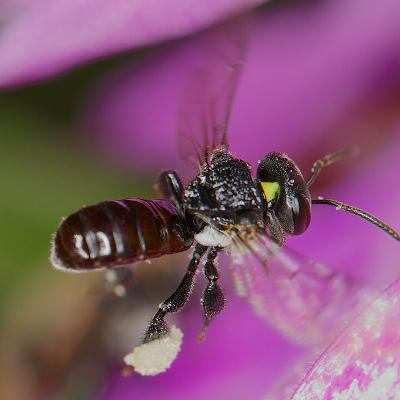

A new study published in eLife reveals how bees use their flight movements to learn and recognize complex visual patterns. Researchers found that the way bees move their bodies while flying helps them gather information about their surroundings. This ability allows bees to identify patterns, like those on flowers, with great accuracy. To understand this, scientists created a computational model to see how these movements work.
The model shows that bee movements create electrical signals in their brains, called neural signals. These signals help bees pick out predictable features in their environment. This active vision process means bees don’t just look at the world - they actively shape what they see. The study suggests that bees can learn complex patterns, such as human faces, even though their brains are tiny, about the size of a sesame seed. This discovery could change how future artificial intelligence (AI), or computer systems that mimic human intelligence, is designed.
Insights for smarter technology
The research also suggests that future robots and self-driving cars could use movement to gather information, making them more efficient. The computational model showed that bee brains adapt by tuning their neurons, the cells that send signals, to specific directions and movements. This happens as bees fly and see different things, refining their responses without needing rewards. The model was tested with real bee challenges, like telling a “plus” sign from a “multiplication” sign. It performed better when it copied bees’ habit of scanning only the lower part of patterns.
Scientists found that bees use very few active neurons to recognize things, saving energy. The study builds on earlier work showing how bees inspect patterns while flying. By combining these findings, the research offers new ideas for biology and technology. It shows that intelligence comes from how brains, bodies, and the environment work together. The study highlights how small brains can solve big problems, providing a model for creating smarter, resource-efficient AI systems.