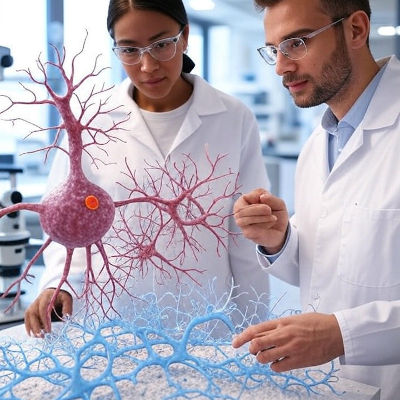

The brain learns and forms memories by changing connections between neurons. These connections, called synapses, grow stronger or weaker over time. This process is known as synaptic plasticity. Synaptic plasticity means the brain reshapes itself at a tiny level. Researchers at Linköping University study how molecules called calcium ion channels help with this. Calcium ion channels are tiny gates in neurons that open and close to control signals.
The study focuses on a specific channel called CaV2.1, the most common in the brain. This channel sits at the synapse, where neurons connect. When a neuron sends an electrical signal, the CaV2.1 channel opens. This releases a chemical called a neurotransmitter. The neurotransmitter carries the signal to the next neuron. The channel acts like a gatekeeper for neuron communication.
The researchers found that long electrical activity affects the channel. It reduces how many CaV2.1 channels can open. Fewer channels mean less neurotransmitter release. This makes the signal to the next neuron weaker. The channel seems to remember past signals. It makes itself unable to open for new signals. Until now, scientists did not know how this happens.
Discovering the memory mechanism
The Linköping researchers uncovered how the channel remembers. The CaV2.1 channel is a large molecule with many parts. These parts move when electrical signals pass through. The channel can take almost 200 different shapes. The shape depends on the signal’s strength and length. During long signals, a key part of the molecule disconnects. This is like a car clutch separating the engine from the wheels. The channel can no longer open. Many signals over time turn most channels into this closed state for seconds.
This short memory in the channel affects the brain over time. It weakens communication between neurons. The receiving neuron changes for hours or days. Over time, these changes become permanent. Weak synapses may disappear. This helps the brain form lifelong memories. The study also helps future medicine. Some diseases are linked to CaV2.1 channel problems. Knowing how the channel works can guide new drug development. The research is published in Nature Communications.