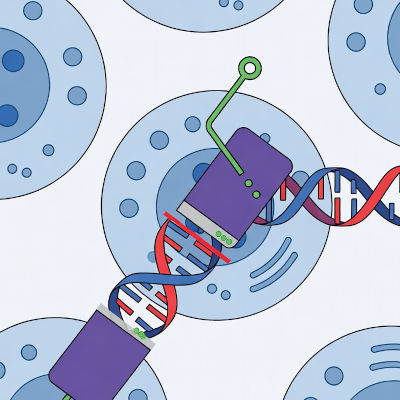

A central challenge in therapeutic genome editing is that CRISPR machinery, once delivered, stays trapped inside whichever cells initially receive it. Since only a fraction of cells in any given tissue can typically be transfected, this ceiling has limited the clinical reach of editing technologies. A new study from the Doudna laboratory at UC Berkeley, pre-published as a bioRxiv preprint, proposes a clever workaround: rather than trying to reach more cells directly, engineer the transfected cells to spread the editing machinery themselves.
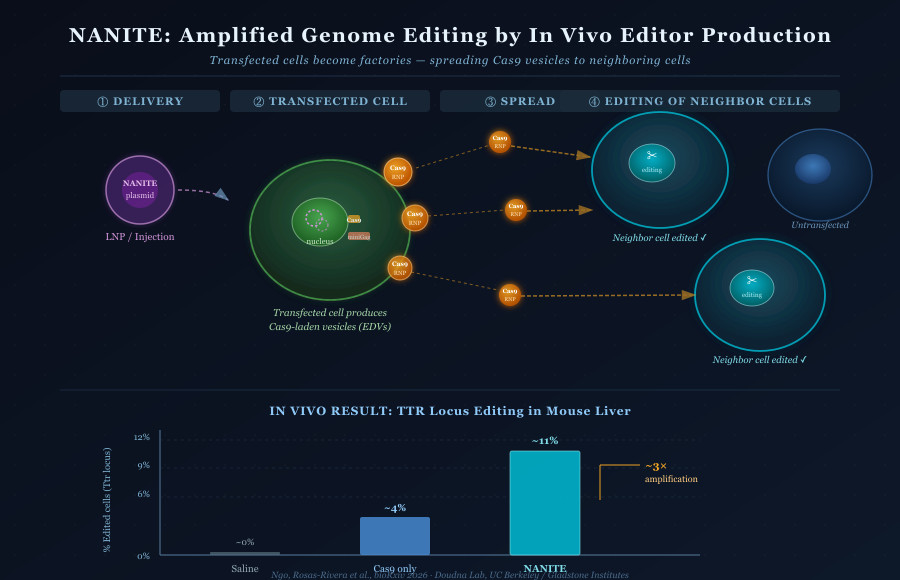
The approach, called NANITE (NANoparticle Induced Transfer of Enzymes), works by encoding all the components needed to assemble and secrete Cas9-containing lipid vesicles onto a single plasmid. When a cell takes up this plasmid, it transiently becomes a producer of tiny vesicles packed with Cas9 ribonucleoproteins, which bud off and fuse with neighboring cells, editing them in turn. The key engineering achievement is consolidating what previously required multiple plasmids into one compact construct using a self-cleaving peptide linker.
Why this matters
In cultured cells, NANITE edited nearly three times as many cells as were originally transfected, with confocal imaging revealing clusters of edited cells radiating outward from transfected ones across multiple cell lengths. The effect held across liver and muscle cell lines. The system can also be targeted: by swapping in cell-type-specific antibody fragments, the authors directed vesicle tropism to cells expressing particular surface receptors with up to 25-fold selectivity.
The most compelling results came from mouse experiments. After transfecting only about 5–8% of liver cells via hydrodynamic injection, NANITE achieved roughly three times more editing at the transthyretin locus than a standard Cas9 control, and reduced serum transthyretin levels by around 40% — approaching thresholds considered clinically meaningful for transthyretin amyloidosis. No significant off-target editing, germline effects, or liver toxicity were detected.
NANITE offers a genuinely new paradigm: making suboptimal delivery therapeutically sufficient by amplifying its effects from within the tissue itself. Rather than trying to deliver cargo to more cells directly, NANITE lowers the bar for how many cells need to be initially transfected by amplifying the effect afterward. SingularityHub compares NANITE to "a benevolent virus."