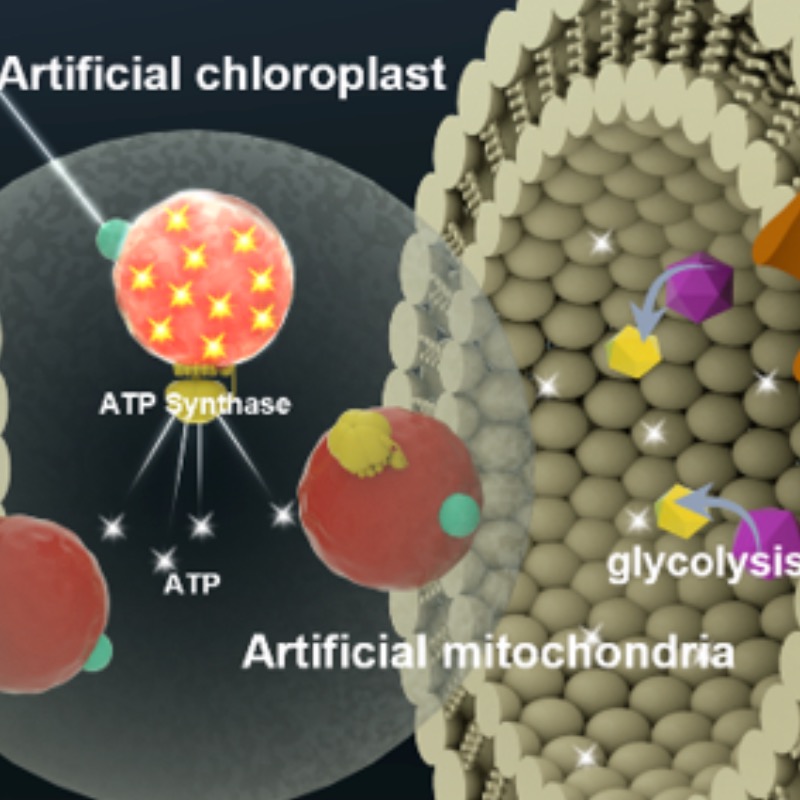

Energy production in nature is the responsibility of mitochondria and chloroplasts, and is crucial for fabricating sustainable, synthetic cells in the lab. Mitochondria are “the powerhouses of the cell,” but are also one of the most complex intracellular components to replicate artificially.
In Biophysics Reviews, by AIP Publishing, researchers from Sogang University in South Korea and the Harbin Institute of Technology in China identified the most promising advancements and greatest challenges of artificial mitochondria and chloroplasts.
“If scientists can create artificial mitochondria and chloroplasts, we could potentially develop synthetic cells that can generate energy and synthesize molecules autonomously. This would pave the way for the creation of entirely new organisms or biomaterials,” author Kwanwoo Shin said.
Key roles of chloroplasts, mitochondria and ATP
In plants, chloroplasts use sunlight to convert water and carbon dioxide into glucose. Mitochondria, found in plants and animals alike, produce energy by breaking down glucose. Once a cell produces energy, it often uses a molecule called adenosine triphosphate (ATP) to store and transfer that energy. When the cell breaks down the ATP, it releases energy that powers the cell’s functions.
“In other words, ATP acts as the main energy currency of the cell, and it is vital for the cell to perform most of the cellular functions,” said author Kwanwoo Shin.
One of the most significant challenges remaining in trying to reconstruct the energy production organelles is enabling self-adaptation in changing environments to maintain a stable supply of ATP. Future studies must investigate how to improve upon this limiting feature before synthetic cells are self-sustainable, the researchers say.
Energy efficiency
The team also described the components required to construct synthetic mitochondria and chloroplasts and they identified proteins as the most important aspects for molecular rotary machinery, proton transport and ATP production.
Previous studies have replicated components that make up energy-producing organelles. Some of the most promising work investigates the intermediate operations involved in the complex energy-generating process. By connecting the sequence of proteins and enzymes, researchers have improved energy efficiency.
The origin of life and cells
The researchers believe its important to create artificial cells with biologically realistic energy-generation methods that mimic natural processes. Replicating the entire cell could also lead to future biomaterials and lend insight into the past.
“This could be an important milestone in understanding the origin of life and the origin of cells,” Shin said.
The article, “Artificial organelles for sustainable chemical energy conversion and production: Artificial mitochondria and chloroplasts,” is authored by Hyun Park, Weichen Wang, Seo Hyeon Min, Yongshuo Ren, Xiaojun Han, and Kwanwoo Shin and is published in Biophysics Reviews on March 28, 2023, https://doi.org/10.1063/5.0131071.