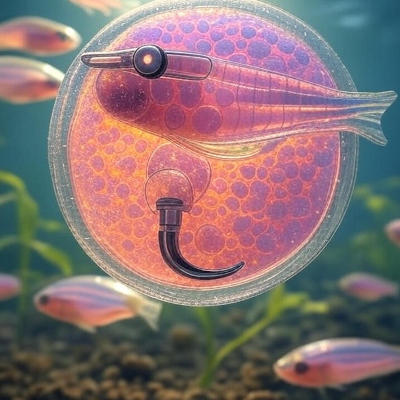

Stem cells are basic cells that can develop into many types. They change into specialized cells through a process called cellular differentiation, which includes cell division to make more cells, fate determination where cells commit to a specific type, and migration where cells move to their final place. Past lab studies outside living bodies (in vitro) showed stem cells can group and specialize on their own.
However, in real animals, or in vivo, the environment is crowded and noisy, with uneven signals between cells and varying gene activity.
Scientists at the University of Alabama at Birmingham and the University of Illinois Chicago focused on how stem cells in the nose, called olfactory stem cells, become olfactory neurons, which are cells that detect smells and can regenerate. The scientists used live zebrafish embryos, which are young fish in early development, to watch this. They applied high-resolution imaging to see details clearly, tracked cell fates quantitatively by measuring changes, and did single-cell RNA sequencing, a method to read gene activity in individual cells.
Signaling mechanisms discovered
The study found a bistable toggle switch, a system like a stable on-off switch with two positions, that gives different roles to starting cells and groups them into cell neighborhoods, small clusters that work together. This helps combine signals across single cells, groups, and whole organs during ongoing brain development. It creates a new way for the olfactory epithelium, the nose lining tissue, to handle random signals, balance stem cells with new ones, and support constant neuron growth in a complex system.
In humans, nose neurons renew every few months lifelong. The work answers how stem cells manage varying signals to repeatedly make neurons. Using zebrafish, researchers plan to check if these paths apply to other animals' nervous systems. In the future, this could lead to treatments for disorders in brain development or neuron loss.
The scientists have described the methods and results of this study in a paper published in Stem Cell Reports.