

Over one billion people worldwide lack any legally recognized identity.
Without proof of identity, individuals cannot open bank accounts, access healthcare systems, vote, or legally own property. In the digital age, invisibility is not merely social—it is infrastructural, locking millions outside modern economic and civic systems.
Blockchain advocates now argue that decentralized identity systems could solve this longstanding problem. Yet the deeper question is not whether identity can be digitized, but who controls recognition in a world where identity becomes programmable.
Identity has always been a technological construct. Passports, birth certificates, and national ID cards are tools designed to establish trust between individuals and institutions. Historically, these systems evolved alongside centralized states, requiring administrative capacity many regions struggled to build.
Digital transformation has intensified the challenge. Governments increasingly digitize services, financial platforms rely on strict verification requirements, and online economies demand persistent identity credentials. For people lacking formal documentation—refugees, rural populations, informal workers—the shift risks deepening exclusion rather than solving it.
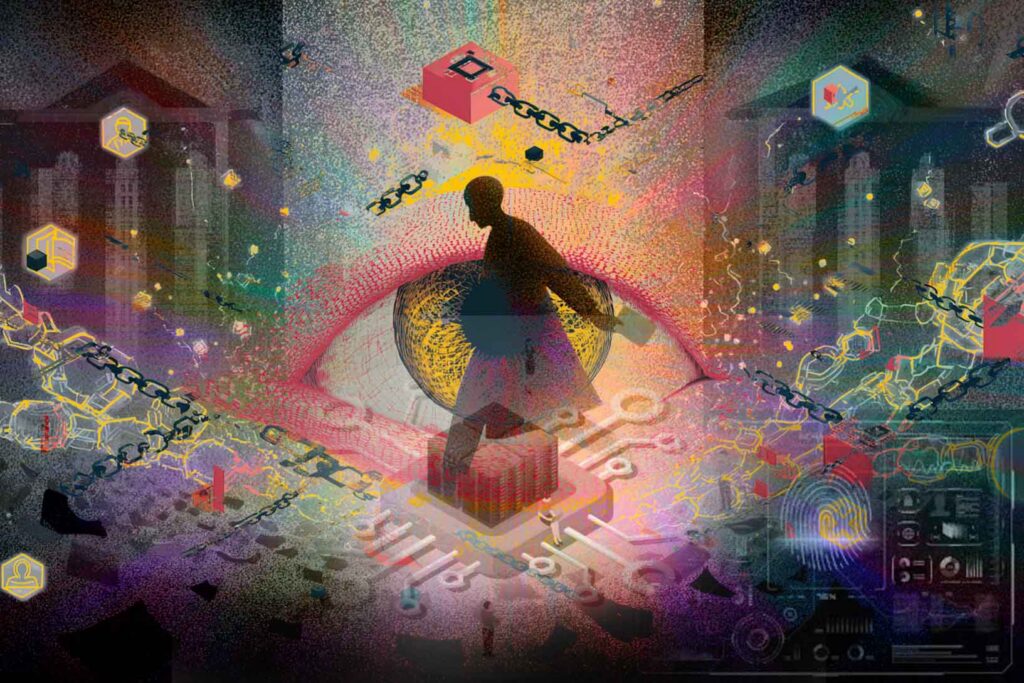
Blockchain-based identity systems emerge at the intersection of decentralization, cryptography, and global development. Instead of relying on a single authority, they propose self-sovereign identity: individuals control verifiable credentials stored securely and shared selectively. The tension lies between empowerment and surveillance—between liberation from bureaucracy and new forms of algorithmic governance.
The Problem of Invisible Citizens
Traditional identity systems assume stable institutions, consistent recordkeeping, and centralized governance. Many communities lack these conditions due to migration, conflict, poverty, or administrative gaps.
Without identity documentation, people become economically invisible. Employers cannot formally hire them, banks cannot verify them, and governments cannot deliver targeted services. Informal solutions emerge, but these often limit upward mobility and long-term stability.
Digital identity promises portability. A farmer, refugee, or street vendor could carry verified credentials independent of national infrastructure, accessible through a mobile device.
Why this matters:
Identity determines access to opportunity; without it, participation in modern society remains conditional.
What Blockchain Actually Changes
Blockchain does not create identity itself—it changes how trust is established. Instead of a central database controlled by one institution, distributed ledgers allow multiple parties to verify credentials without needing a single authority.
In decentralized identity models, individuals hold cryptographic keys linked to credentials issued by trusted entities such as schools, clinics, or local organizations. Verification becomes a process of confirming authenticity rather than requesting permission from a centralized registry.
This architecture reduces single points of failure and corruption risks. Records cannot easily be altered or erased, which is especially valuable in politically unstable environments where identity records may be lost or manipulated.
Why this matters:
Trust shifts from institutions alone to cryptographic verification systems.
Self-Sovereign Identity and Digital Agency
Self-sovereign identity reframes individuals as owners of their personal data rather than subjects of institutional databases. Users choose when and how to share information, revealing only necessary attributes instead of entire records.
For example, proving adulthood may require confirming age without revealing birthdate or nationality. Such selective disclosure protects privacy while maintaining verification reliability.
This model aligns with broader movements toward data ownership and digital autonomy. However, it also introduces new responsibilities: managing private keys, understanding permissions, and maintaining digital security become personal obligations.
Why this matters:
Empowerment increases autonomy but transfers complexity to individuals.
Infrastructure Without Borders
One of blockchain identity’s most radical implications is portability across borders. Migrants and displaced populations could maintain persistent identity credentials independent of changing jurisdictions.
In theory, this enables continuity of education records, medical histories, and employment credentials across regions. Aid organizations and service providers could verify identities quickly without rebuilding records from scratch.
Yet interoperability remains a major challenge. Competing standards and fragmented implementations risk creating isolated identity ecosystems rather than a universal framework.
Why this matters:
Global mobility requires identity systems that move with people, not governments.
The Hidden Political Dimension
Identity systems are never neutral. They determine who exists within legal and economic frameworks. Decentralized identity may reduce dependence on states, but it also introduces private actors—technology platforms, consortiums, and standards bodies—as new governance authorities.
If corporations control identity infrastructure, power may shift away from public institutions without necessarily empowering citizens. Conversely, purely state-controlled digital identity systems risk surveillance and social control.
The future likely lies in hybrid governance models balancing decentralization with accountability.
Why this matters:
Identity technology is fundamentally about power, not just verification.
Adoption Barriers and Practical Realities
Despite strong theoretical advantages, real-world adoption faces obstacles. Digital literacy gaps, smartphone access, and infrastructure limitations remain significant challenges.
Trust also matters. Communities historically excluded by institutions may hesitate to adopt unfamiliar digital systems, particularly those perceived as foreign or experimental.
Successful deployments increasingly involve local partnerships, community onboarding, and human-centered design approaches rather than purely technical solutions.
Why this matters:
Technology succeeds when social systems evolve alongside it.
Ethics & Societal Implications
Blockchain identity raises paradoxical ethical questions. Systems designed to empower individuals could also enable unprecedented tracking if improperly implemented. Permanent digital records risk transforming identity into an immutable history, limiting the human capacity for reinvention or forgiveness.
Equity concerns are equally significant. If digital identity becomes mandatory for accessing services, those unable or unwilling to participate may face deeper exclusion. The “invisible billion” could become digitally visible yet structurally constrained.
The philosophical challenge lies in defining identity itself. Is identity a state-issued privilege, a technological construct, or a human right? As decentralized systems evolve, societies must decide whether identity infrastructures should prioritize efficiency, freedom, or collective accountability.
Conclusion
Blockchain identity systems promise recognition for those long excluded from formal systems, potentially reshaping how humanity defines belonging in the digital age. By shifting trust from centralized institutions to distributed verification, they challenge centuries-old assumptions about authority and citizenship.
Yet visibility alone does not guarantee empowerment. The real transformation will depend on governance, inclusivity, and human-centered design. As identity becomes programmable, the defining question emerges: will decentralized identity liberate individuals from bureaucracy—or simply encode bureaucracy into code?